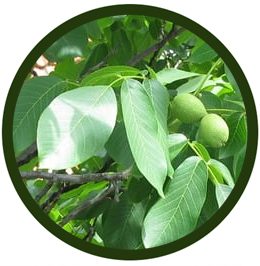
The walnut is a large deciduous tree native to the Near East and central Asia, cultivated since ancient times for its edible fruit, the walnut, and for its valuable timber.
| Kingdom | Plantae |
| Division | Tracheophyta |
| Class | Magnoliopsida |
| Order | Fagales |
| Family | Juglandaceae |
| Genus | Juglans |
| Species | Juglans regia |
The walnut is a large tree that can reach about 25 metres in height, with a sturdy trunk more than 2 metres in diameter and a broad, rounded crown. Its leaves, 20 to 35 cm long, are made up of between 5 and 9 leaflets.
The fruit, the walnut, is a drupe 3 to 6 cm in diameter, covered by a green, fleshy husk that darkens and splits away as it ripens, exposing the woody stone with its characteristic brain-like shape.
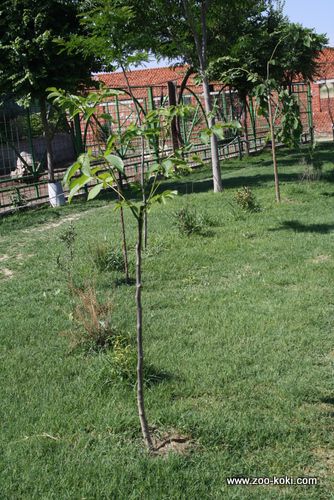
The walnut is native to the Near East, and its cultivation goes back thousands of years. It was introduced to northern and western Europe before Roman times, and today it is distributed naturally across south-west and central Asia as far as the Himalayas.
Its scientific name, Juglans, comes from the Latin contraction of “Jovis glans”, that is, “Jupiter's acorn”. Its timber has traditionally been highly prized in fine cabinet-making and for musical instruments.