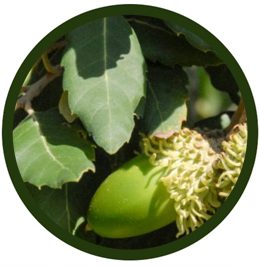
The cork oak is a Mediterranean evergreen tree famous for its thick, corky bark, which can regenerate after each stripping.
| Kingdom | Plantae |
| Division | Magnoliophyta |
| Class | Magnoliopsida |
| Order | Fagales |
| Family | Fagaceae |
| Genus | Quercus |
| Species | Quercus suber |
It is a medium-sized evergreen tree that can reach between 20 and 25 metres in height. Its most characteristic feature is its bark: thick, spongy and deeply fissured, from which cork is harvested every nine or ten years without harming the tree.
Its leaves are leathery, with a slightly toothed margin and the underside covered in fine greyish down. Like other oaks, it produces elongated acorns inside a scaly cup.
It is endemic to the western Mediterranean, occurring in the south of the Iberian Peninsula, North Africa, Corsica and Sardinia. It forms forests (cork oak woodlands, or “alcornocales”) on acidic, siliceous soils, especially in areas with some Atlantic or coastal influence.
Spain, together with Portugal, is one of the world's largest cork producers. The first stripping of a cork oak is not carried out until the tree is about 25 years old, and from then on it can be repeated every nine or ten years for centuries.