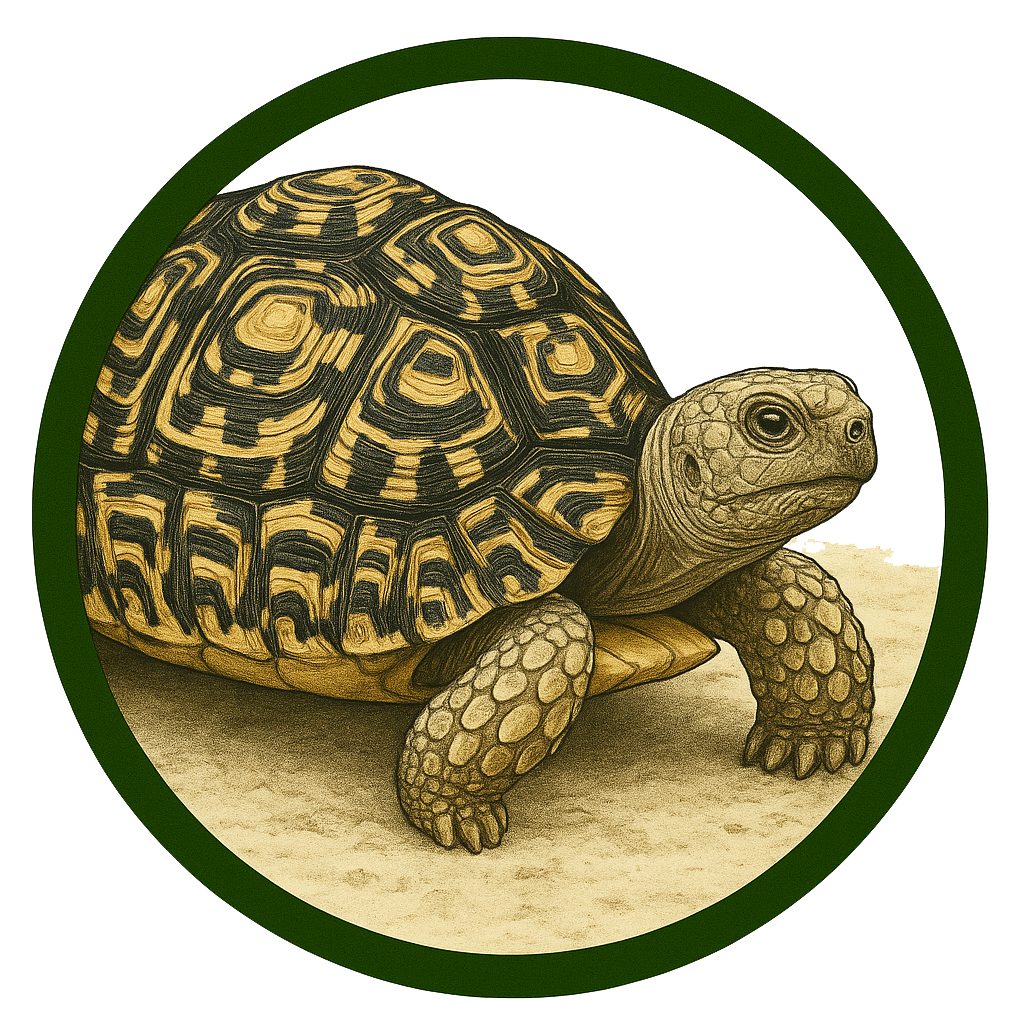
The leopard tortoise ( Stigmochelys pardalis ) is a large land tortoise of the family Testudinidae, the fourth largest tortoise species in the world.
| Kingdom | Animalia |
| Phylum | Chordata |
| Class | Reptilia |
| Order | Testudines |
| Family | Testudinidae |
| Genus | Stigmochelys |
| Species | Stigmochelys pardalis |
The leopard tortoise (Stigmochelys pardalis) is a large land tortoise of the family Testudinidae, the fourth largest tortoise species in the world. Its highly domed shell shows a striking pattern of irregular black blotches on a yellow background, unique to each individual and similar to that of a leopard.
Adults usually measure between 35 and 40 cm and weigh between 13 and 18 kg, although some individuals exceed 50-60 cm and 40 kg; the populations of Ethiopia and Somalia can exceptionally reach a metre in length.
It is widely distributed across sub-Saharan Africa, from Sudan to South Africa, inhabiting savannas and semi-arid grasslands from sea level up to 2,500 metres above sea level.
It is strictly herbivorous, preferring grasses and plants rich in fibre and calcium; an unbalanced diet, rich in protein or phosphorus but poor in calcium, can cause shell deformities.
It reaches sexual maturity at between 12 and 15 years in the wild. Females lay between 5 and 30 eggs per clutch (on average 8-10), which are incubated for 130 to 180 days at temperatures of 28-30 °C and high humidity.
It can live for around a century, and during the rainy season it is able to stay submerged and hold its breath for up to 10 minutes.