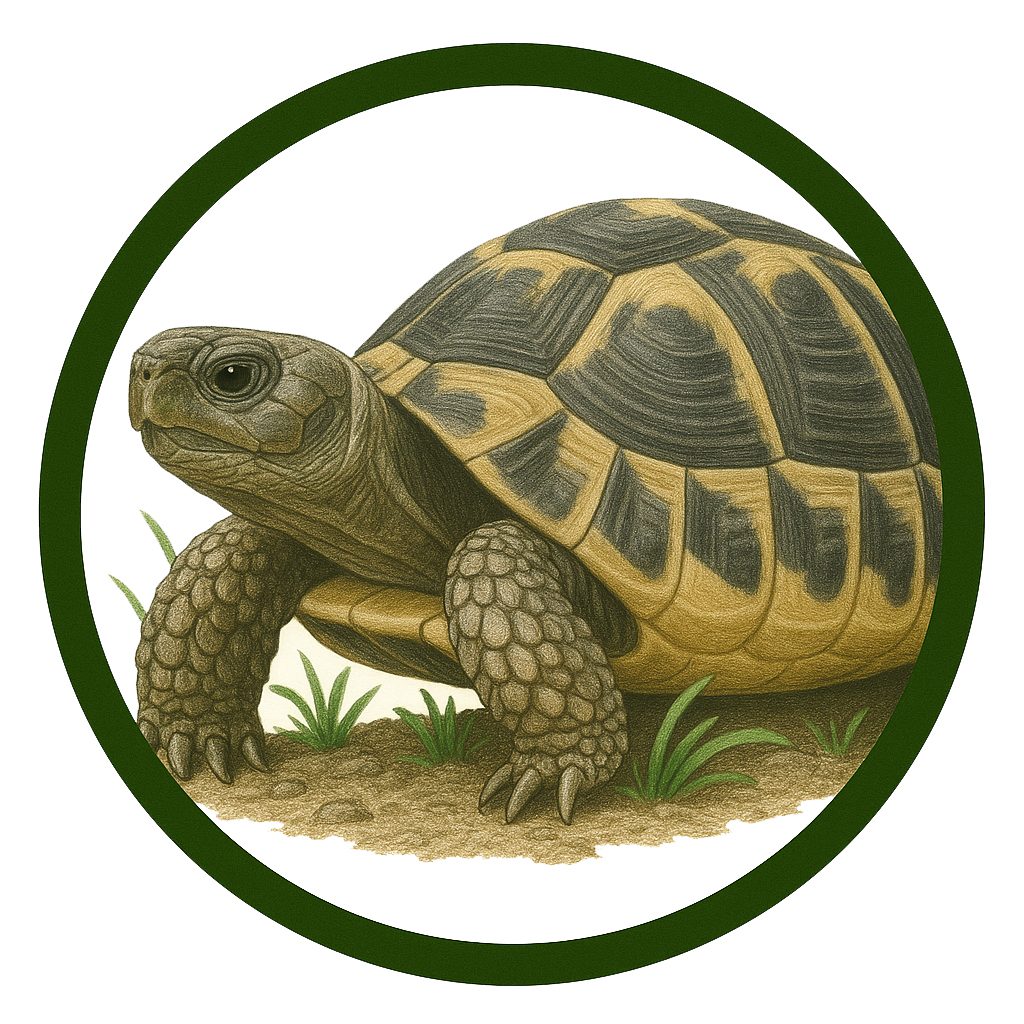
Hermann's tortoise (Testudo hermanni) is one of the eight tortoise species traditionally classified within the genus Testudo, together with closely related species such as the marginated tortoise (T. marginata), the spur-thighed tortoise (T.
| Kingdom | Animalia |
| Phylum | Chordata |
| Class | Reptilia |
| Order | Testudines |
| Family | Testudinidae |
| Genus | Testudo |
| Species | Testudo hermanni |
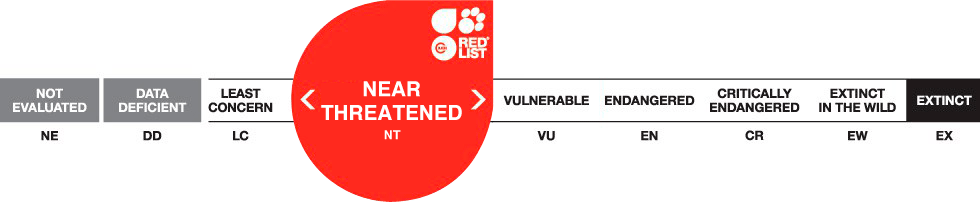
Hermann's tortoise (Testudo hermanni) is one of the eight tortoise species traditionally classified within the genus Testudo, together with closely related species such as the marginated tortoise (T. marginata), the spur-thighed tortoise (T. graeca) or the Russian tortoise (T. horsfieldii).
These are herbivorous, diurnal reptiles that can generally reach ages comparable to those of humans, and are distributed from the Iberian Peninsula in the west to the southern edge of the Black Sea in the east. Together with the marginated tortoise (T. marginata), it is the only land tortoise with a distribution entirely within Europe. Habitat destruction and their popularity as pets have significantly decimated wild populations and made their protection essential to ensure the long-term future of the species.
For T. hermanni hermanni, the carapace length of adult individuals varies from a minimum of thirteen centimetres in males from Apulia to a maximum of twenty-two centimetres in females from Sardinia. The base colour of the carapace is orange-yellow with diffuse black blotches, which extend widely over the plastron. The pectoral seam (in red in the photo) is shorter than the femoral seam (in purple). Other characteristics are the yellow pigmentation of the scales below the eyes, absent in adult T. h. boettgeri, and a characteristic keyhole-shaped pattern beneath the supracaudal scute.

This subspecies is found in France, Italy and Spain. In Spain it occurs in the Albera, Garraf and Montsant mountains, in the Ebro Delta, and also on Mallorca and Menorca. In France it is found in the Maures mountains and on Corsica, and in Italy in Tuscany, Apulia, Sicily and northern Sardinia.
The basis of their diet is wild plants: alfalfa, thistles, dandelion, plantain, clover, yarrow, honeysuckle, rosemary, sage, lemon balm, chicory, watercress and lamb's lettuce are suitable vegetation for feeding tortoises thanks to their high calcium-to-phosphorus ratio and their fibre content. High levels of protein or phosphorus combined with a meagre calcium intake cause permanent deformities of the carapace and damage to the internal organs.
An obvious symptom of poor feeding is a carapace with pointed, grooved scutes along the seams, a phenomenon known as pyramiding. By contrast, a smooth, oval-shaped carapace indicates a correct diet.
They are very long-lived animals, and many centenarian individuals are known. They reach sexual maturity at around nine years of age. Testudo species are oviparous: they lay their eggs in holes dug in the ground by the female with her hind feet. T. hermanni females lay eggs two or three times a year, between May and June. The number of eggs depends on the size of the individual.
The incubation time, between two and three months, and the sex of the hatchlings vary according to the ambient temperature. If the incubation temperature is below 31.5 °C, males will predominate, and if the temperature is higher, there will be more females. Temperatures below 26 °C or above 33 °C cause malformations or the death of the embryo. When hatching day arrives, often hastened by a rainy day, the baby tortoise breaks the egg open using a horny tubercle located between the external nostrils and the upper jaw, which disappears after a few days. Hatching lasts forty-eight hours, a period during which the yolk sac is completely absorbed.
Hermann's tortoises are at risk of disappearing in the wild mainly because of human-related factors such as mechanised agriculture and the use of pesticides, traffic, fires, habitat destruction, urbanisation, illegal collection and the threat of new predators (above all because of the introduction in the eighties of Hungarian wild boar, more voracious than the native ones). The capture of tortoises as human food appears to be non-existent, although according to Vetter Testudo Hermanni is still eaten as food in some rural regions of Bulgaria.
For some years now, although it is legally prohibited to take Testudo species from the wild, the number of captive individuals today is far greater than that of wild ones. The number of captive tortoises (not kept for commercial purposes) is estimated at tens of thousands, which points to the need for a greater effort in environmental education.
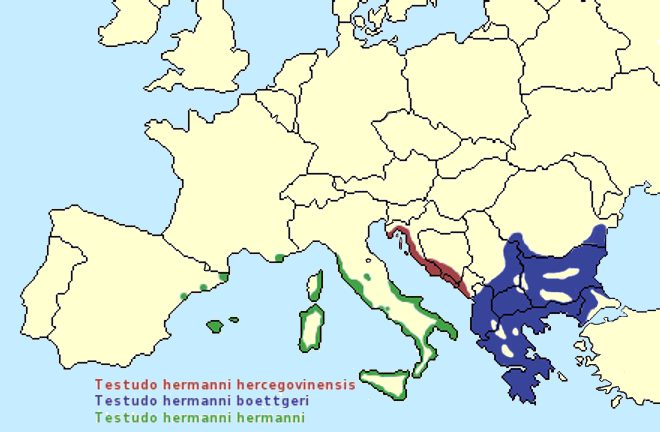 Source: Wikimedia Commons — Testudo hermanni range map.jpg