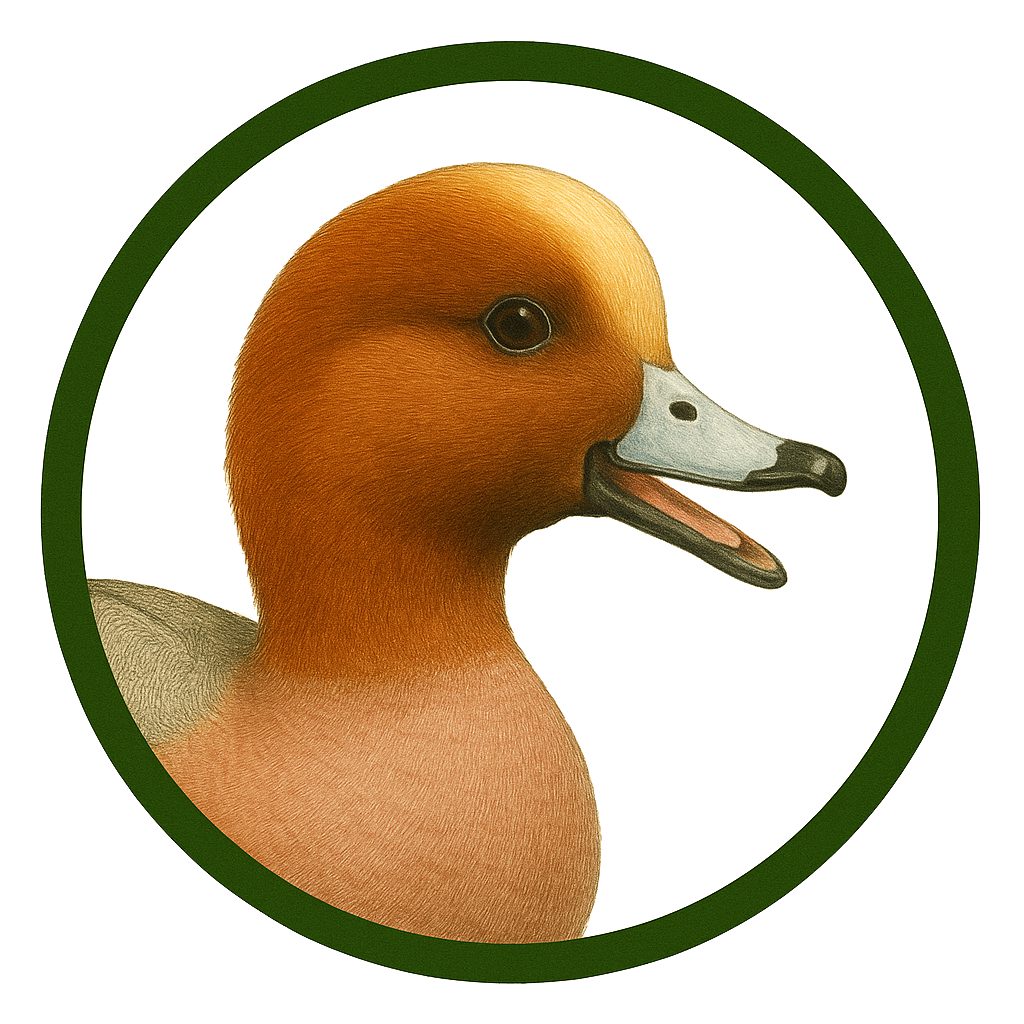
The Eurasian wigeon ( Mareca penelope ) is a medium-sized duck in the family Anatidae, measuring between 42 and 50 cm in length, with a wingspan of 71 to 80 cm and a weight that can exceed a kilogram.
| Kingdom | Animalia |
| Phylum | Chordata |
| Class | Aves |
| Order | Anseriformes |
| Family | Anatidae |
| Genus | Mareca |
| Species | Mareca penelope |
The Eurasian wigeon (Mareca penelope) is a medium-sized duck in the family Anatidae, measuring between 42 and 50 cm in length, with a wingspan of 71 to 80 cm and a weight that can exceed a kilogram. The male in breeding plumage stands out for its reddish-chestnut head with a cream-coloured stripe on the forehead, pinkish breast, grey body, and black rear with a white belly. The female, by contrast, has drab brown plumage that allows her to blend in during incubation.
This species breeds in the northern parts of Europe and Asia, and spends the winter much further south, in southern Europe, northern Africa and parts of Asia. On the Iberian Peninsula it is a common winter visitor, especially between September and November, frequenting open wetlands: inland fresh waters during the breeding season and coastal or brackish areas in winter.
It feeds mainly on aquatic plants, which it takes by swimming on the surface of the water or by grazing directly on meadows close to wetlands and marshes. Outside the breeding season it is very gregarious and forms large flocks.
The female builds the nest on the ground, hidden among bushes or herbaceous vegetation near the water, in the form of a hollow lined with grasses and down. The clutch usually consists of 8 to 9 eggs, although it can reach 12, and incubation is carried out by the female alone for about 22-25 days. The chicks are nidifugous (precocial) and leave the nest a few hours after hatching.
The Eurasian wigeon owes its name to the characteristic high-pitched whistle made by the males, very different from the hoarser sound of the females. It is also a long-distance migrant, capable of covering thousands of kilometres between its breeding grounds in the Arctic and its wintering quarters.