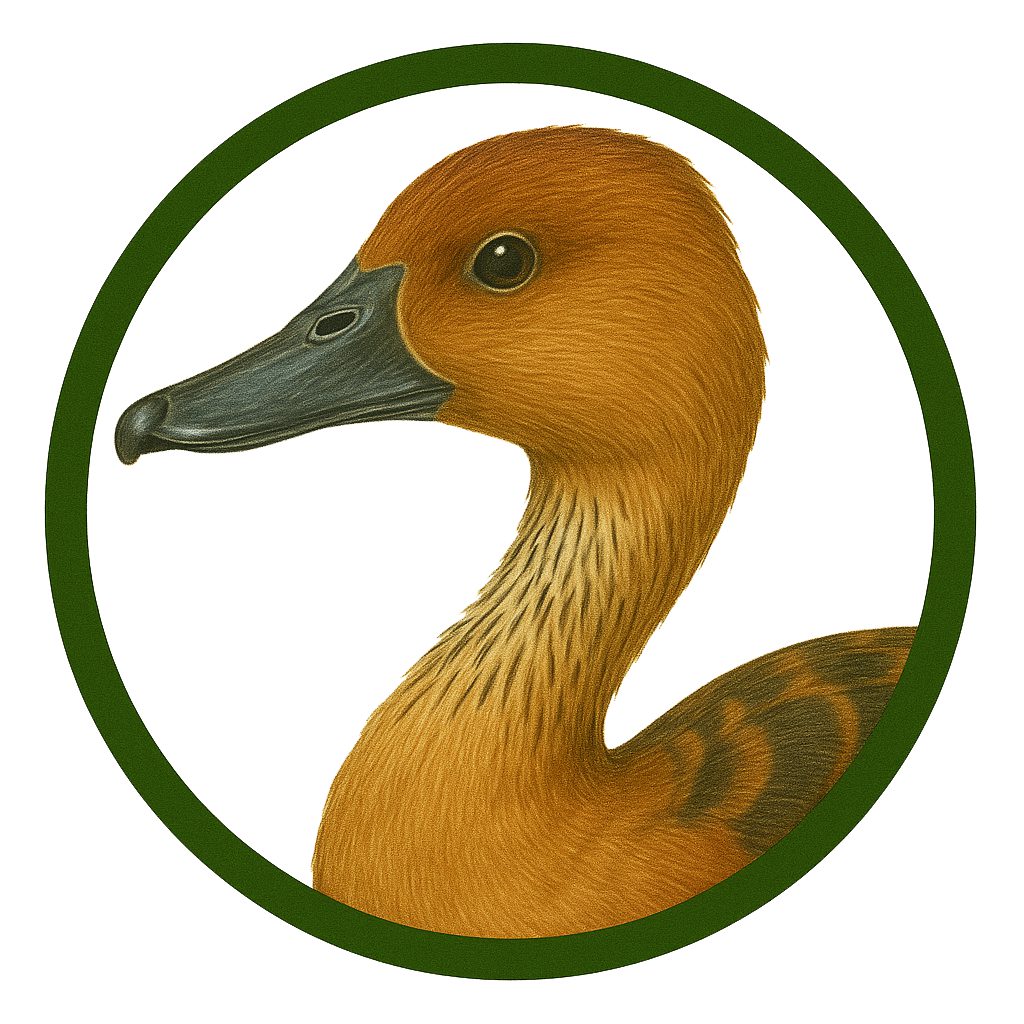
The white-faced whistling duck ( Dendrocygna viduata ) is a species of whistling duck in the family Anatidae, roughly 50 cm long, with a wingspan of nearly 90 cm and a weight of up to 700 g.
| Kingdom | Animalia |
| Phylum | Chordata |
| Class | Aves |
| Order | Anseriformes |
| Family | Anatidae |
| Genus | Dendrocygna |
| Species | Dendrocygna viduata |
The white-faced whistling duck (Dendrocygna viduata) is a species of whistling duck in the family Anatidae, roughly 50 cm long, with a wingspan of nearly 90 cm and a weight of up to 700 g. Its common name refers to the characteristic white face, which contrasts with the black of the rest of the head and neck. The plumage is very similar in both sexes, with a reddish-brown body and the belly and flanks barred in black and white.
It has a very wide distribution that spans both the Americas and Africa. In the Americas it extends from Costa Rica, through Colombia, Venezuela and the Amazon basin, to north-central Argentina, as well as the Antilles, Cuba and the Dominican Republic. In Africa it lives in the equatorial zone south of the Sahara and in Madagascar. It occupies wetlands such as lagoons, lakes, marshes, flooded fields and shallow rivers with abundant vegetation, from sea level up to 1,000 metres in altitude.
It feeds by filtering shallow water in search of plants, seeds, small invertebrates, molluscs, insects and crustaceans.
It nests on the ground among tall grasses or on low branches of trees close to the water. The clutch consists of 6 to 12 eggs, which are incubated by both parents for a period of 26 to 30 days.
It is a very vocal bird with crepuscular habits, known for its characteristic, flute-like call. In some parts of its range there is a popular belief that its song announces the arrival of rain.