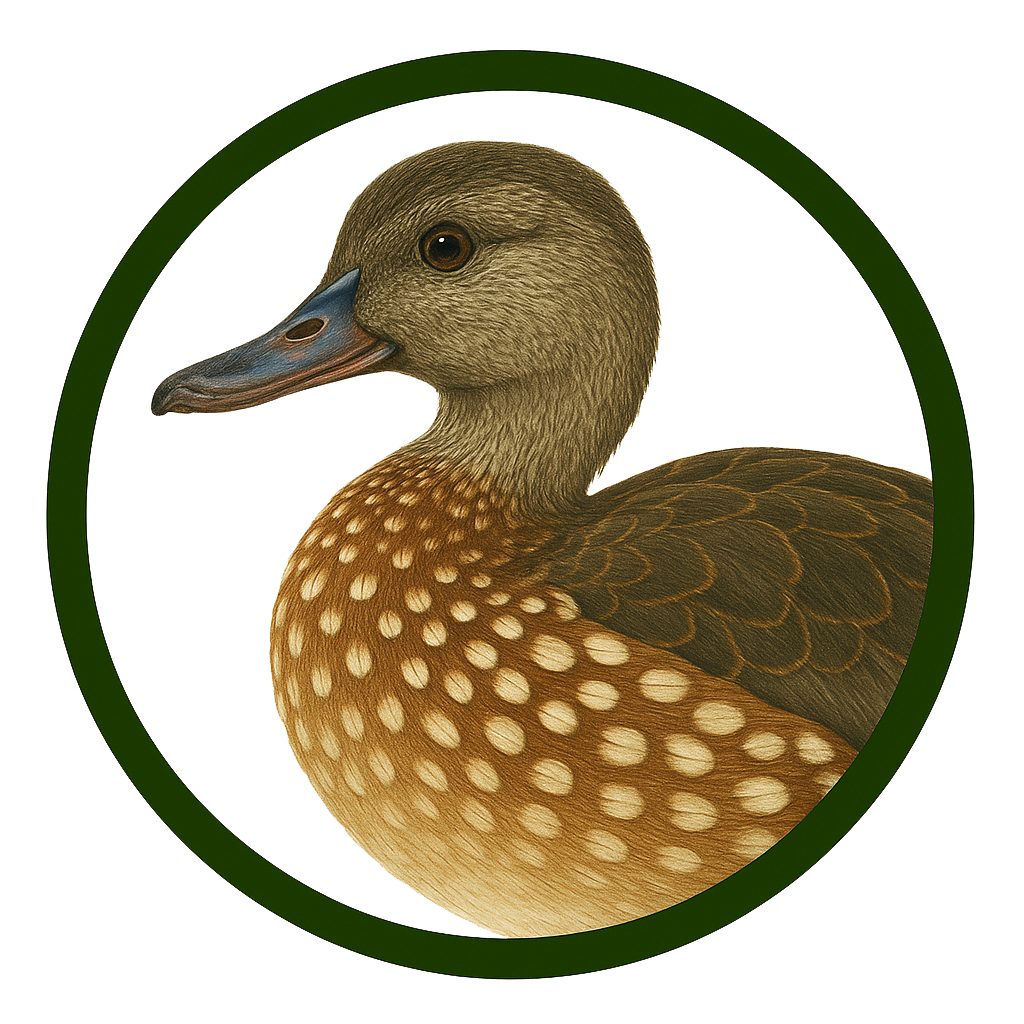
The spotted whistling duck ( Dendrocygna guttata ) is one of the smallest species of the genus Dendrocygna , measuring 43 to 50 cm in length; males weigh between 590 and 650 grams and females, slightly more, between 610 and 860 grams.
| Kingdom | Animalia |
| Phylum | Chordata |
| Class | Aves |
| Order | Anseriformes |
| Family | Anatidae |
| Genus | Dendrocygna |
| Species | Dendrocygna guttata |
The spotted whistling duck (Dendrocygna guttata) is one of the smallest species of the genus Dendrocygna, measuring 43 to 50 cm in length; males weigh between 590 and 650 grams and females, slightly more, between 610 and 860 grams. It is characterised by the white spots that speckle its flanks and breast, the sides of the neck, the greyish face and eyebrows, and a black or dark brown crown that extends down to the nape. Its legs are a dull pink with black webbing between the toes, and the bill is dark, sometimes with reddish areas and white markings.
Although its common name recalls that of other South American birds, the spotted whistling duck is native to the Malay Archipelago and Oceania: it is found in the south of the Philippines, the islands of Wallacea, New Guinea and the far north of Australia, on the Cape York Peninsula. It lives in small lagoons and marshes surrounded by trees, in low-lying wet areas.
It feeds on grass seeds, invertebrates and aquatic plants, and occasionally on small fish, searching for food by diving and filtering, mainly at night.
The breeding season runs from September to April. It nests in tree hollows close to the water, where it may rear several clutches of 10 to 11 eggs per season. Both parents incubate the eggs for 18 to 31 days, and the chicks fly at between 45 and 50 days old.
Although its name "suirirí" evokes South American species, this bird in fact belongs to the avifauna of Asia-Oceania, being one of the few whistling ducks native to South-East Asia and Australia.