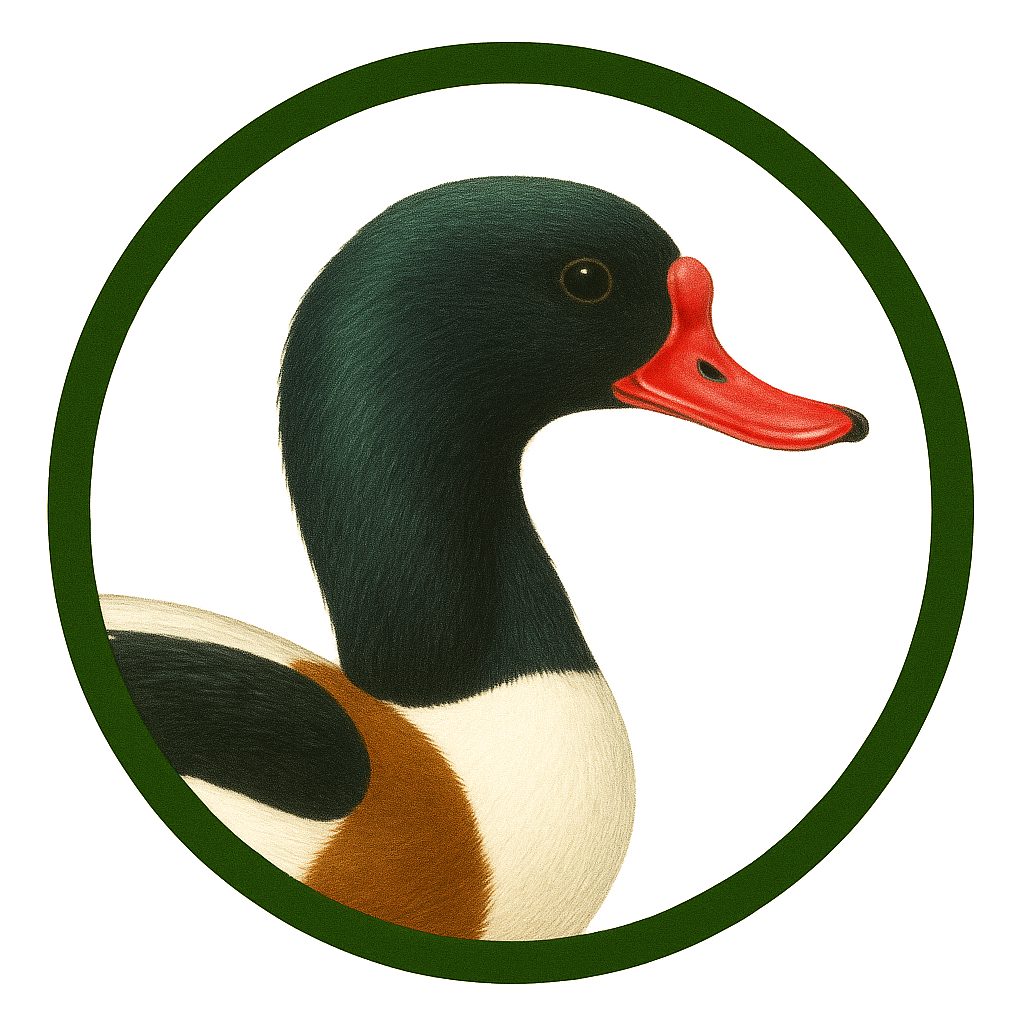
The common shelduck ( Tadorna tadorna ) is a waterfowl intermediate in appearance between a duck and a goose, described by Linnaeus in 1758.
| Kingdom | Animalia |
| Phylum | Chordata |
| Class | Aves |
| Order | Anseriformes |
| Family | Anatidae |
| Genus | Tadorna |
| Species | Tadorna tadorna |
The common shelduck (Tadorna tadorna) is a waterfowl intermediate in appearance between a duck and a goose, described by Linnaeus in 1758. Its plumage is mainly white, with black areas and a broad reddish-chestnut breast band that also encircles the mantle; the head and upper neck are black with a greenish sheen. It has a red bill and pink legs, and males show a knob at the base of the bill, like a frontal shield, which becomes more pronounced in the breeding season.
It breeds in the temperate zone of Eurasia; a good part of the populations migrate to subtropical areas in winter, although others remain all year round in broad coastal areas of western Europe. On the Iberian Peninsula it is mainly a winter visitor, although it breeds occasionally in some wetlands; the first confirmed nesting in Spain was recorded in the Ebro Delta in 1972. It lives in estuaries, shallow coasts and the shores of inland brackish lagoons, in open terrain.
It feeds mainly on molluscs, small crustaceans and insects, and to a lesser extent on plant matter, searching for food in shallow water or on wet meadows.
It nests in cavities away from the water, often in rabbit burrows dug into dunes or sandy banks. The clutch consists of between 3 and 12 bright white eggs, commonly 8-10, which the female incubates for 29 to 31 days while the male stays nearby. The ducklings sometimes have to travel long distances from the nest to the rearing areas, where they form large groups together with the young of other families.
After breeding, most pairs abandon their ducklings, which are gathered into crèches looked after by a few adult females, while the rest of the population migrates to quiet stretches of coast to complete their moult, a period during which they temporarily lose the ability to fly.