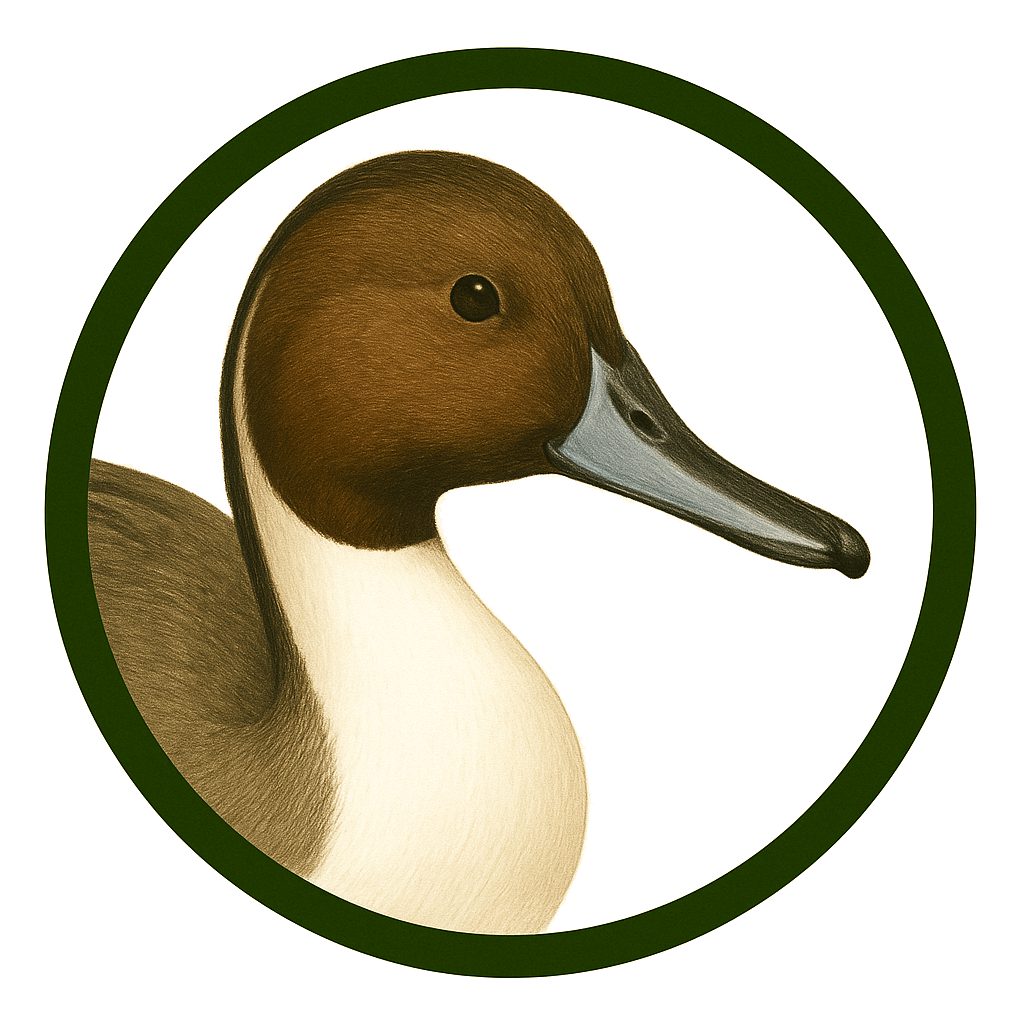
The northern pintail ( Anas acuta ) is a dabbling duck with a slender body and marked sexual dimorphism.
| Kingdom | Animalia |
| Phylum | Chordata |
| Class | Aves |
| Order | Anseriformes |
| Family | Anatidae |
| Genus | Anas |
| Species | Anas acuta |
The northern pintail (Anas acuta) is a dabbling duck with a slender body and marked sexual dimorphism. In breeding plumage, the male has a chocolate-brown head and neck that contrast with its white underparts and grey back with black-centred feathers, and two long central tail feathers, up to 10 cm, which give the species its name. The female has mottled greyish-brown plumage and a shorter, pointed tail. It measures between 59 and 76 cm in length and weighs between 450 and 1,360 g.
It breeds in open, treeless wetlands of northern Eurasia and North America — tundra, wet meadows and lake shores — and winters in southern Europe, northern Africa, Central America and tropical and subtropical regions of Asia. Outside the breeding season it is very gregarious and often forms mixed flocks with other species of ducks.
It feeds by up-ending with its head under the water, thanks to its long neck, which allows it to reach food down to 30 cm deep, beyond the reach of other ducks such as the mallard. In winter it eats mainly the seeds and rhizomes of aquatic plants, while in the breeding season it feeds mostly on invertebrates such as insects, molluscs and crustaceans.
It reaches sexual maturity at one year of age. The breeding season runs from April to June, with clutches of 7 to 9 cream-coloured eggs that the female incubates alone for 22 to 24 days. The ducklings fly about 46-47 days after hatching.
The northern pintail is a great migrant: there is a record of a ringed bird from Labrador (Canada) that was shot in England just nine days later, which shows how quickly it can make transatlantic journeys. The maximum recorded lifespan for the species is 27 years and 5 months.