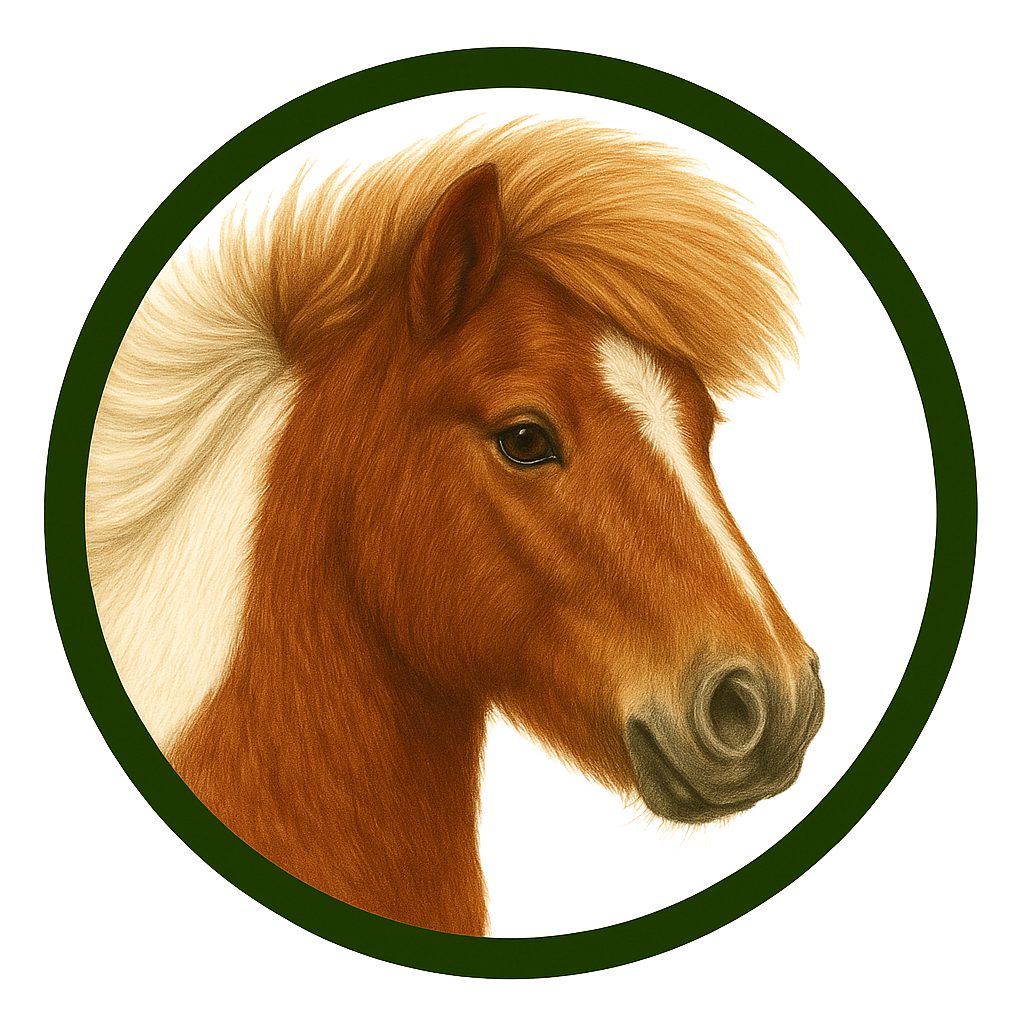
The pony is a group of small horse breeds ( Equus ferus caballus ), with more than 55 recognised breeds worldwide.
| Kingdom | Animalia |
| Phylum | Chordata |
| Class | Mammalia |
| Order | Perissodactyla |
| Family | Equidae |
| Genus | Equus |
| Species | Equus ferus caballus |

The pony is a group of small horse breeds (Equus ferus caballus), with more than 55 recognised breeds worldwide. Ponies are characterised by a sturdy body, dense bones, rounded forms and well-sprung ribs, a short head, large eyes and small ears. By definition, a pony does not exceed 14.2 hands (about 147 cm) at the withers, with an average weight of around 100 kg.
Ponies are considered to be descended from one of the four primitive types of horse of Eurasia. The Exmoor pony, native to Great Britain, is the oldest known breed, already used by the ancient inhabitants of Britain before the Roman occupation.
Their metabolism is very efficient: they need roughly half as much hay per kilo of body weight as a horse, and can often do without concentrate feed altogether, although this same efficiency makes them more vulnerable to laminitis and Cushing's syndrome if they are overfed.
Males can breed from the age of two, although in controlled breeding it is generally preferable to wait until three or four. Gestation lasts about 320 days and birth is extremely quick, barely ten minutes from the start of contractions; foals suckle for the first time within two hours of birth.
Despite their size, ponies are extraordinarily strong animals in relation to their weight, able to pull loads of up to 450% of their own body weight.