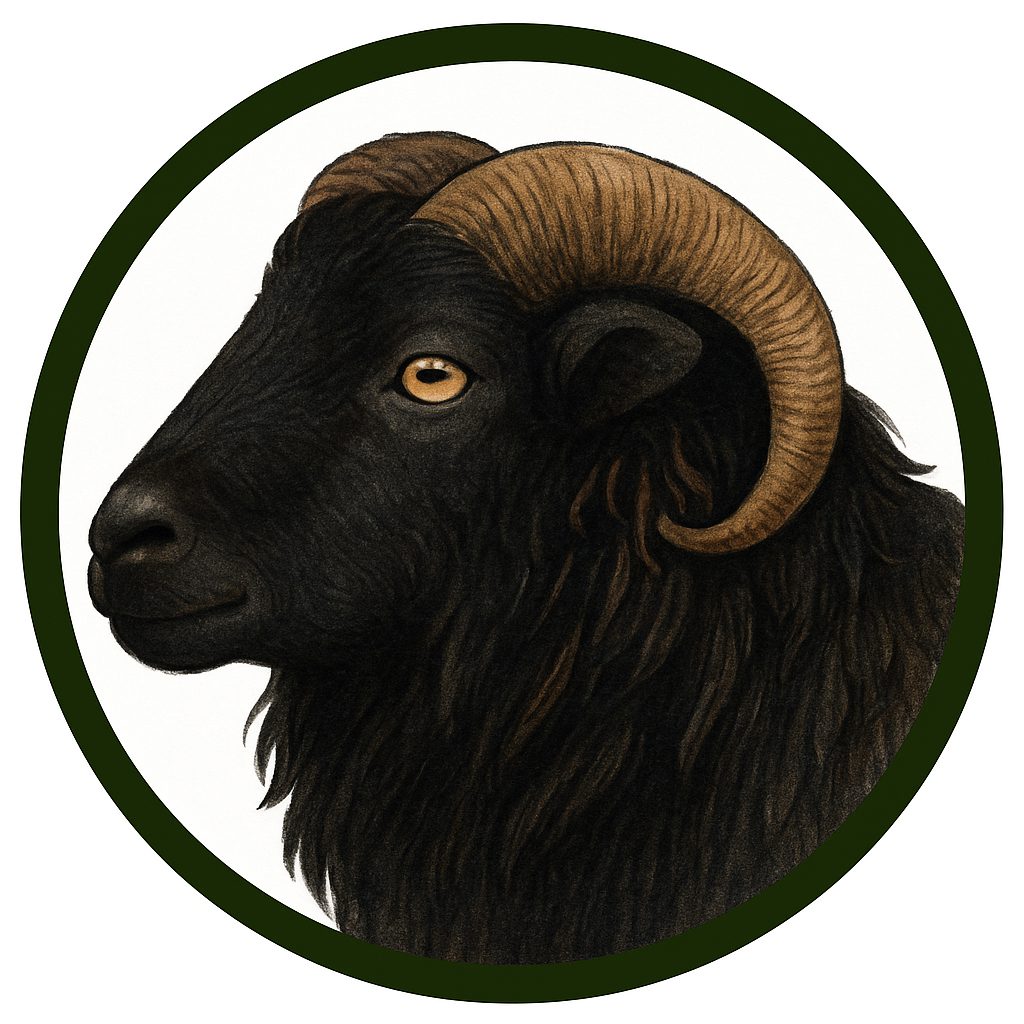
The Ouessant sheep is a breed of sheep ( Ovis aries ) considered the smallest in Europe, with adults barely reaching 16 kg in weight.
| Kingdom | Animalia |
| Phylum | Chordata |
| Class | Mammalia |
| Order | Artiodactyla |
| Family | Bovidae |
| Genus | Ovis |
| Species | Ovis aries |
The Ouessant sheep is a breed of sheep (Ovis aries) considered the smallest in Europe, with adults barely reaching 16 kg in weight. Its coat can come in different colours: black is the original, although there are also white individuals —documented since the late 19th century—, as well as grey and brown ones.
This breed takes its name from the island of Ouessant, a small territory of barely one square kilometre off the coast of Brittany, in the French Atlantic. There is evidence of sheep on the island from 750-450 BC, although continuity with the present-day breed has not been confirmed; the first written references date from the 17th century. The breed came close to disappearing and was rescued from 1976 onwards from the surviving flocks on the mainland.
It is a very hardy breed, able to adapt to all kinds of climates and spaces, with minimal feeding and care requirements. It stays outdoors all year round, except in heavy snow.
The main lambing season runs from February to September. It is neither usual nor desirable for ewes to lamb twice a year.
In 1856, a census of the island of Ouessant counted 4,190 ewes and lambs, along with 1,713 rams. Nowadays, this miniature breed is also used as an «ecological lawnmower» in vineyards and green spaces.