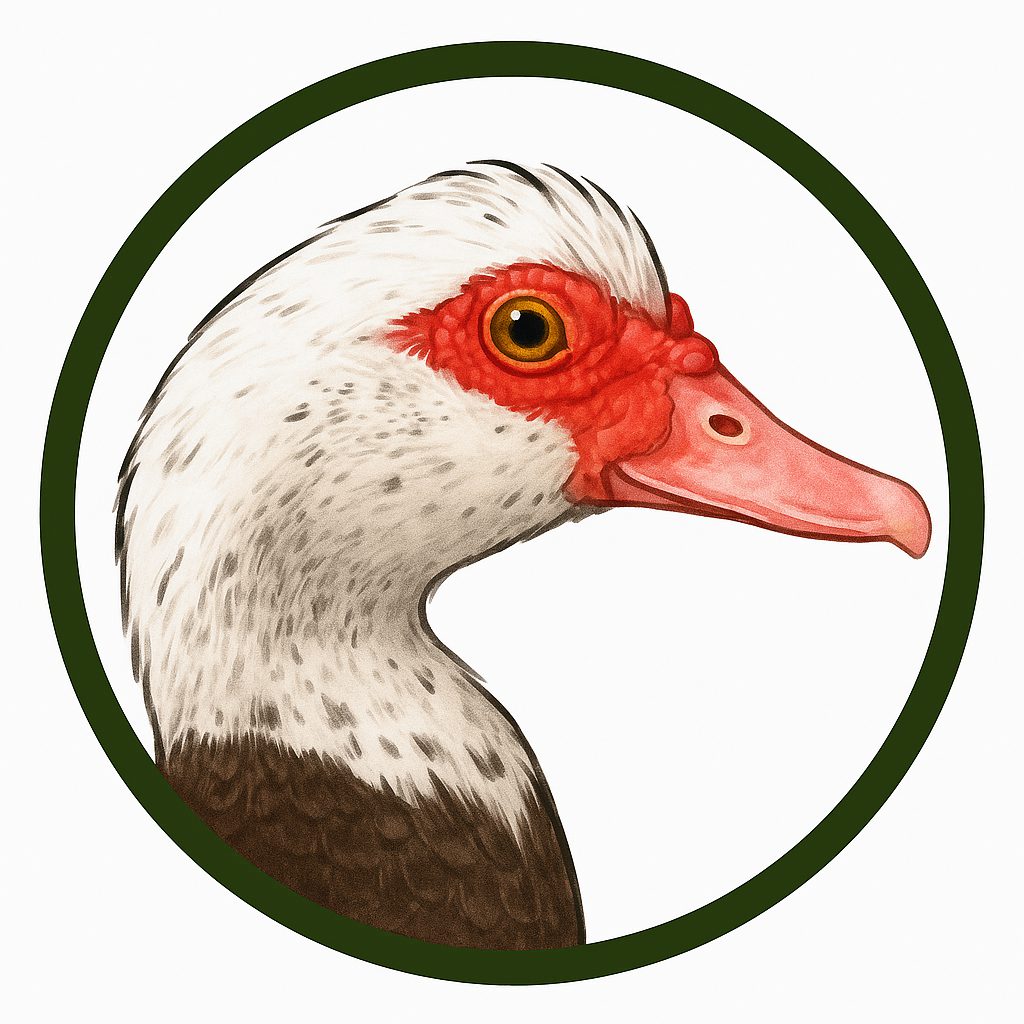
The Muscovy duck ( Cairina moschata ) is a large duck, up to 76 cm long in its wild form.
| Kingdom | Animalia |
| Phylum | Chordata |
| Class | Aves |
| Order | Anseriformes |
| Family | Anatidae |
| Genus | Cairina |
| Species | Cairina moschata |
The Muscovy duck (Cairina moschata) is a large duck, up to 76 cm long in its wild form. The male has black plumage with a metallic sheen, while the female is a duller black; both show white wing patches that are visible in flight. One of its most distinctive features is the reddish or pinkish skin caruncles around the bill, which are more developed in males.
There is also a domestic form (C. m. domestica), which is heavier, has limited flight and shows highly variable plumage that can be white, black, brown or a mixture of tones.
Its natural range extends from Mexico to central Argentina and Uruguay, in tropical and subtropical climates, from sea level up to 1,000 m above sea level. It prefers wooded areas close to fresh water, such as wetlands, lagoons and slow-flowing rivers, where it often perches on branches over the water.
It is a bird with very versatile foraging habits, able to feed on aquatic vegetation in open areas, which makes it suitable even for production systems integrated with fish farming.
It nests in tree hollows and sheltered spots near the water. During the breeding season the males give off a characteristic musky smell, which is the origin of its scientific name.
Despite its common name, the Muscovy duck is not actually mute: it does make vocalisations, although much quieter than those of other ducks. It was domesticated by the indigenous peoples of Mesoamerica before the arrival of the Europeans, and today its commercial rearing for meat is concentrated above all in France, China, Vietnam and Taiwan. Crossed with the mallard or the Pekin duck, it produces sterile hybrids, known as "mule ducks", traditionally used in the production of foie gras.