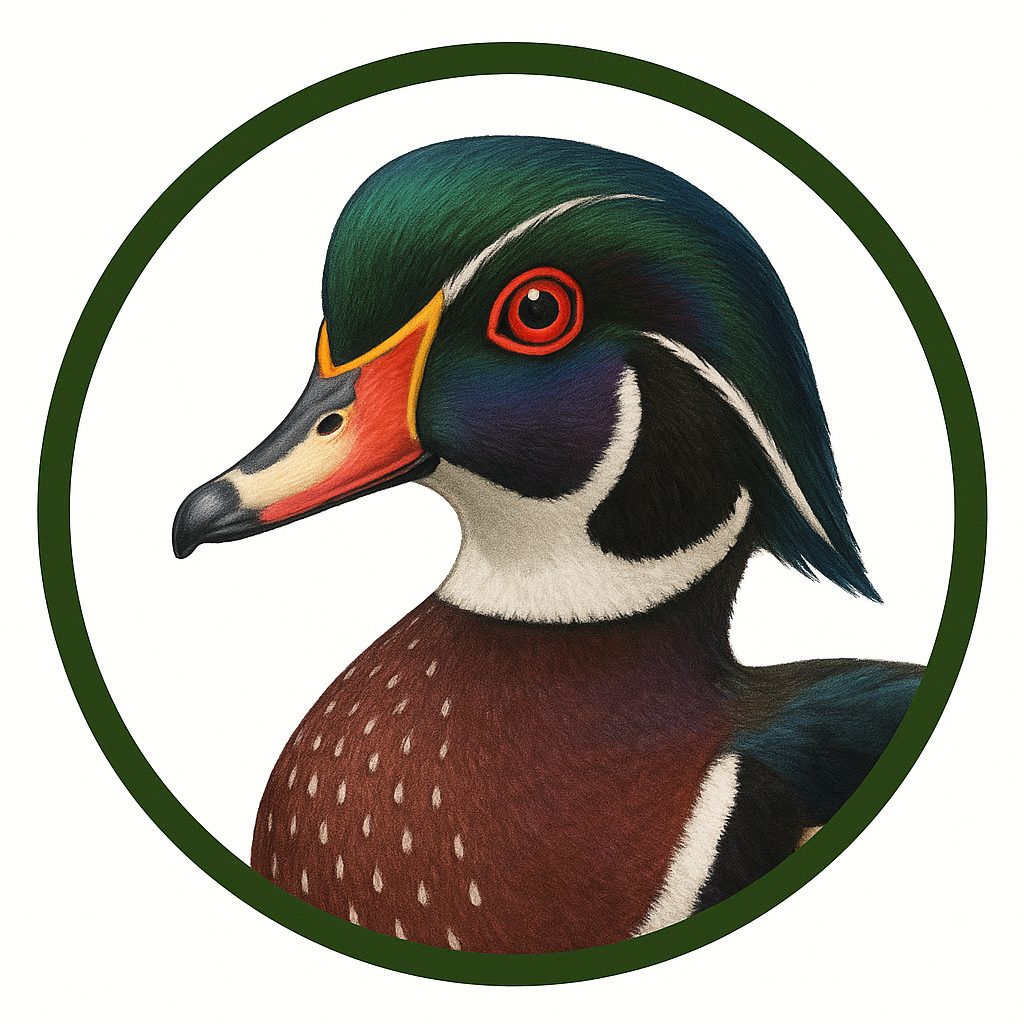
The wood duck ( Aix sponsa ) is a medium-sized duck, about 50 cm long with a 75 cm wingspan, roughly three-quarters the size of a mallard.
| Kingdom | Animalia |
| Phylum | Chordata |
| Class | Aves |
| Order | Anseriformes |
| Family | Anatidae |
| Genus | Aix |
| Species | Aix sponsa |
The wood duck (Aix sponsa) is a medium-sized duck, about 50 cm long with a 75 cm wingspan, roughly three-quarters the size of a mallard. It shows marked sexual dimorphism: the male has a strikingly showy, multicoloured iridescent head, while the female is much more discreet in colour, greyish-brown, with a characteristic white ring around the eye.
It is native to the east and west coasts of the United States, where it inhabits lakes and wetlands with abundant tree cover; there are also populations in Cuba and Puerto Rico. It has been introduced in several European countries, although without becoming as widely established as the Mandarin duck.
It is an omnivorous species that feeds on acorns, seeds and berries, as well as insects; it is able to swallow acorns whole and crush them in its gizzard.
It nests in tree cavities close to water, sometimes at great height, and readily accepts artificial nest boxes. The clutch consists of 7 to 15 eggs, with an incubation period of 28 to 37 days (30 on average). The day after hatching, the ducklings jump from the nest —sometimes from more than 15 metres up— and head for the water.
Unlike most ducks, the wood duck has sharp claws on its feet that allow it to perch and climb on tree branches. It is also one of the few North American duck species able to raise two broods in the same year in the southernmost parts of its range.