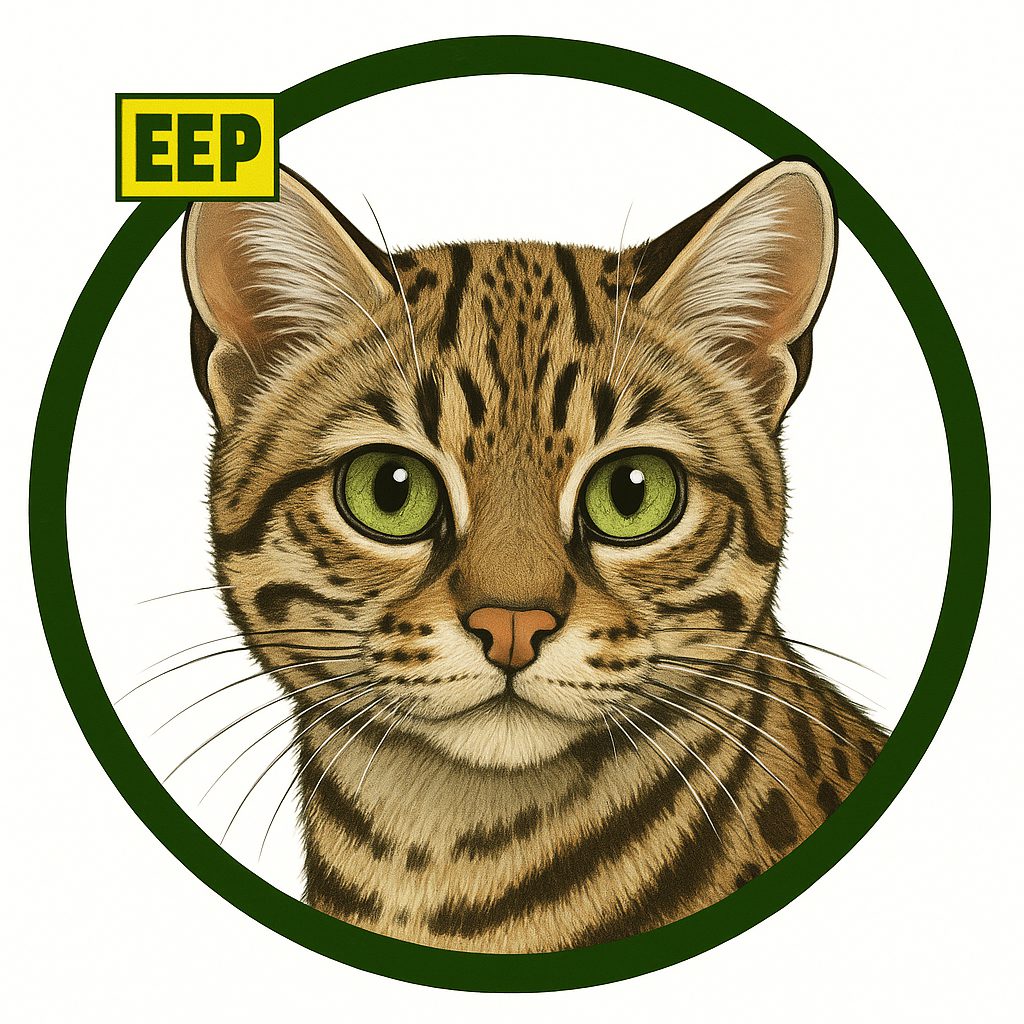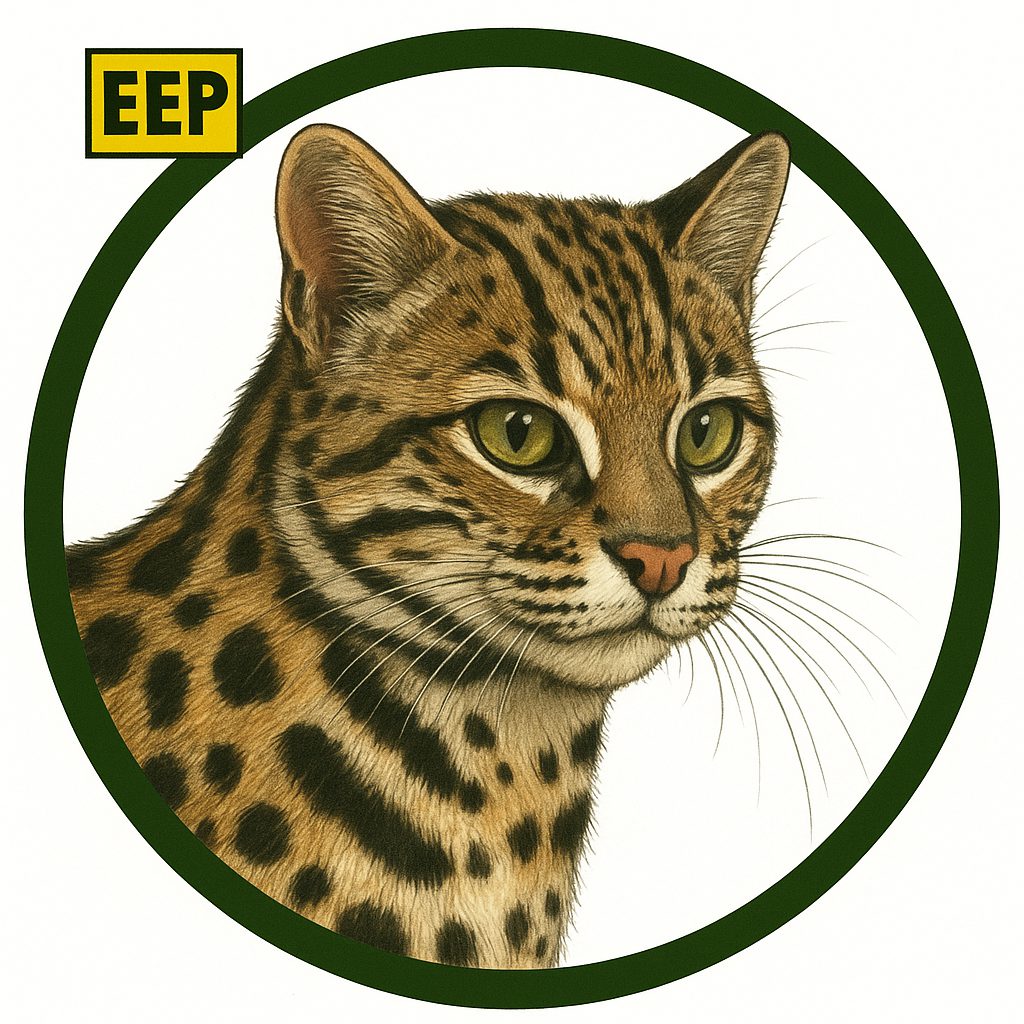
Kazan, Khulnâ and Kaneda A leopard cat is roughly the size of a domestic cat, but slimmer with longer legs. Its small head is marked with two prominent dark stripes and a short, narrow white muzzle.
| Kingdom | Animalia |
| Phylum | Chordata |
| Class | Mammalia |
| Order | Carnivora |
| Suborder | Feliformia |
| Family | Felidae |
| Subfamily | Felinae |
| Genus | Prionailurus |
| Species | Prionailurus bengalensis |
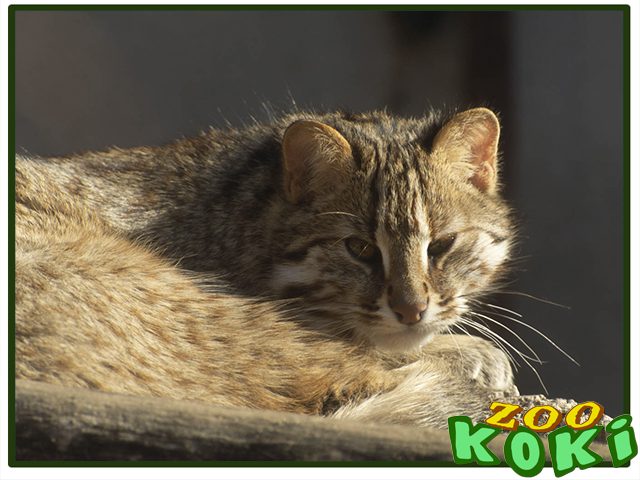
Kazan, Khulnâ y Kaneda
A leopard cat is roughly the size of a domestic cat, but slimmer with longer legs. Its small head is marked with two prominent dark stripes and a short, narrow white muzzle. It has two dark stripes running from the eyes to the ears and small white stripes running from the eyes to the nose. The backs of its moderately long, rounded ears are black with a central white spot. Its body and limbs are marked with black spots of varying size and colour, and two to four rows of elongated spots run along the back. The tail is about half the length of its head-and-body length and is dotted with a few black rings. The coat is orange-brown with a white chest and belly, although a pale silvery grey on other areas. In the tropics, leopard cats weigh 0.55 to 3.8 kg, with head-and-body lengths of 38.8 to 66 cm and tails of 17.2 to 31 cm. In northern China and Siberia, they can weigh up to 7.1 kg and have head-and-body lengths of up to 75 cm; in general, they put on weight before winter and slim down by spring.
Leopard cats are the most widely distributed Asian cats. Their range extends from the Amur region in the Russian Far East across the Korean peninsula, China, Indochina and the Indian subcontinent, west into northern Pakistan, and south to the Philippines and the islands of Indonesia. They are found in areas used for agriculture, but prefer wooded habitats. They live in evergreen tropical rainforests and plantations at sea level, in subtropical deciduous forests and in coniferous forests in the foothills of the Himalayas at heights above 1000 m above sea level.
Leopard cats are carnivores and feed on a wide variety of small prey, including mammals, lizards, amphibians, birds and insects. Across most of their range, small rodents such as rats and mice make up most of their diet, which is often supplemented with grasses, eggs, birds and aquatic prey. In Thailand, at Khao Nang Rum Station, 52 droppings were analysed and the diet was found to consist of the red spiny rat.
There are 11 subspecies
Prionailurus bengalensis alleni
Prionailurus bengalensis bengalensis, India, Bangladesh, south-west Asia, Yunnan.
Prionailurus bengalensis borneoensis, Borneo.
Prionailurus bengalensis chinensis, China, Taiwan, the Philippines.
Prionailurus bengalensis euptailurus, far eastern Siberia, Mongolia, Manchuria.
Prionailurus bengalensis heaneyi
Prionailurus bengalensis horsfieldi, Himalayas.
Prionailurus bengalensis javanensis, Java.
Prionailurus bengalensis rabori
Prionailurus bengalensis sumatranus, Sumatra.
Prionailurus bengalensis trevelyani, far eastern Pakistan.