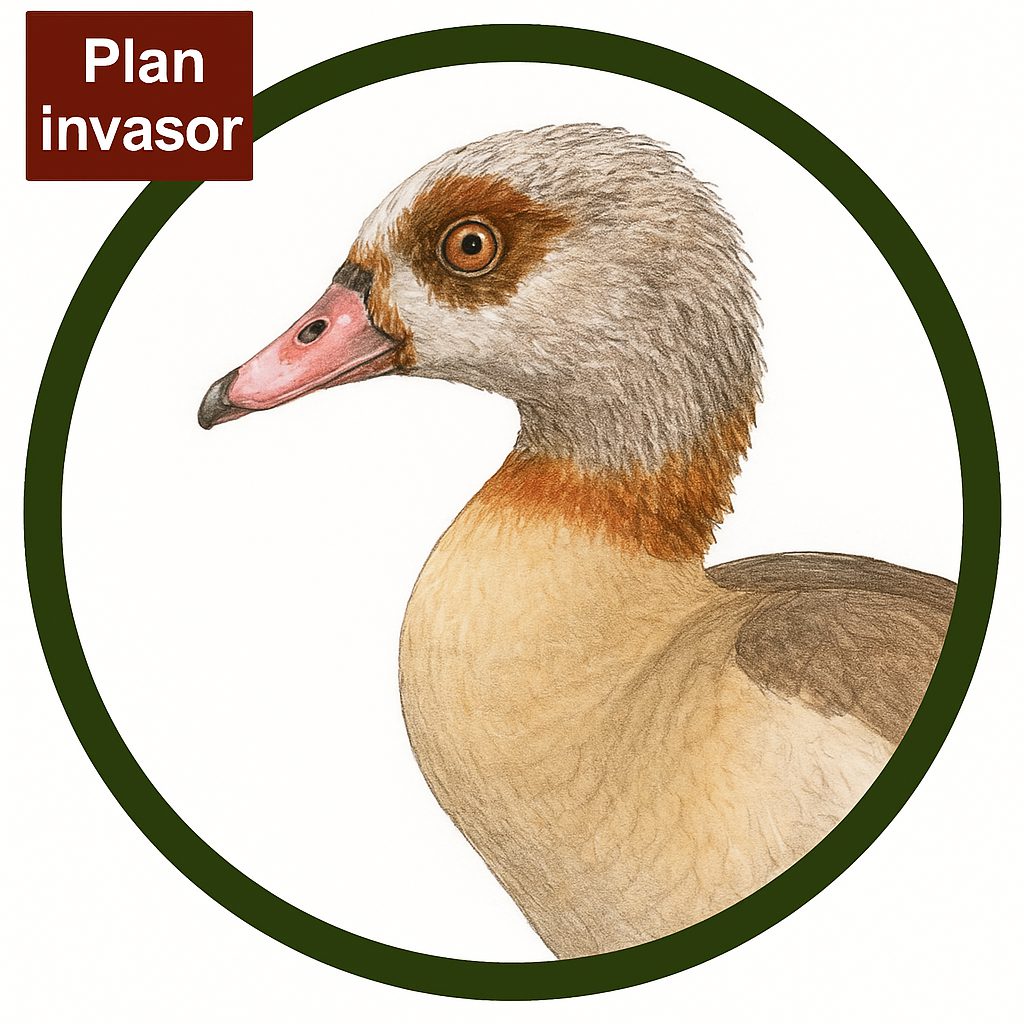
The Egyptian goose ( Alopochen aegyptiaca ) is the only living species in its genus and, despite its name, is more closely related to the shelducks (subfamily Tadorninae) than to true geese.
| Kingdom | Animalia |
| Phylum | Chordata |
| Class | Aves |
| Order | Anseriformes |
| Family | Anatidae |
| Genus | Alopochen |
| Species | Alopochen aegyptiaca |
The Egyptian goose (Alopochen aegyptiaca) is the only living species in its genus and, despite its name, is more closely related to the shelducks (subfamily Tadorninae) than to true geese. It is a medium-sized bird, 63 to 73 cm long and weighing between 1.5 and 2.3 kg, with brown and greyish plumage, a dark patch around the eye and large white patches on the wings that are hidden at rest and become very visible in flight or during alarm displays.
It is native to sub-Saharan Africa and the Nile valley, where it occupies open or semi-open habitats near fresh water, from the lowlands up to 4,000 m above sea level, avoiding dense forests and deserts. Outside its native range it has become established as an introduced species in several European countries.
It feeds mainly on grasses, leaves and cereal crops; the chicks, on the other hand, initially depend on small aquatic invertebrates and freshwater plankton.
It is a monogamous species in which both parents look after the young. It nests in the hollows of mature trees or directly on the ground, and the female lays between 5 and 12 eggs, which she incubates for 28 to 30 days. The chicks are precocial and can feed themselves from the moment they hatch.
The Egyptian goose was a revered bird in Ancient Egypt and is frequently depicted in Egyptian art. Today, its introduced populations in Europe — including Spain, where its introduction, possession and trade are prohibited — are considered potentially invasive because of their ability to colonise new territories and compete with native species.