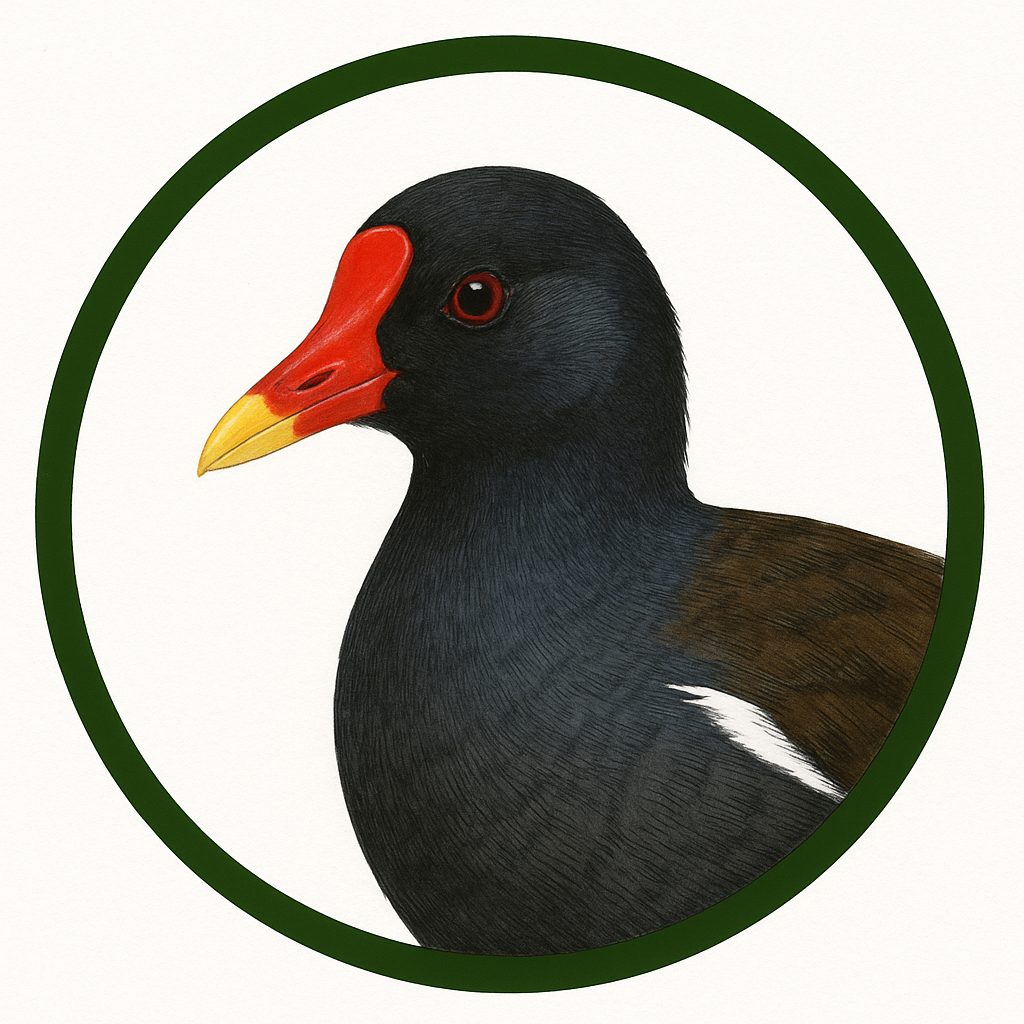
The common moorhen ( Gallinula chloropus ) is a bird of the family Rallidae, originally described by Linnaeus in 1758.
| Kingdom | Animalia |
| Phylum | Chordata |
| Class | Aves |
| Order | Gruiformes |
| Family | Rallidae |
| Genus | Gallinula |
| Species | Gallinula chloropus |

The common moorhen (Gallinula chloropus) is a bird of the family Rallidae, originally described by Linnaeus in 1758. It is a medium-sized rail, 30 to 38 cm long, with a wingspan of 50 to 62 cm and a weight of between 192 and 500 g. Its plumage is a blackish grey, darker on the head and neck, with white undertail coverts and a white line along the flank. It stands out for its red frontal shield and bill with a yellow tip, its yellowish-green legs with a red patch at the knee, and its long, unwebbed toes.
It is widely distributed across Eurasia and Africa, and northern populations migrate seasonally. It lives in marshes, rivers and lakes with abundant vegetation, adapting well to a wide variety of wetlands.
It eats a wide variety of plant material and small aquatic animals, searching for food both on land and in the water, walking over floating leaves or partly submerging its head while swimming.
Breeding begins between March and May in temperate regions. The first clutch usually consists of about 8 eggs, and later ones of between 4 and 8. Incubation, carried out by both parents, lasts about three weeks, and the chicks, which are also fed by the adults, take to the air at 40-50 days.
Although it does not have webbed feet like ducks, it is an excellent swimmer thanks to its long toes, which also allow it to walk over floating vegetation without sinking.