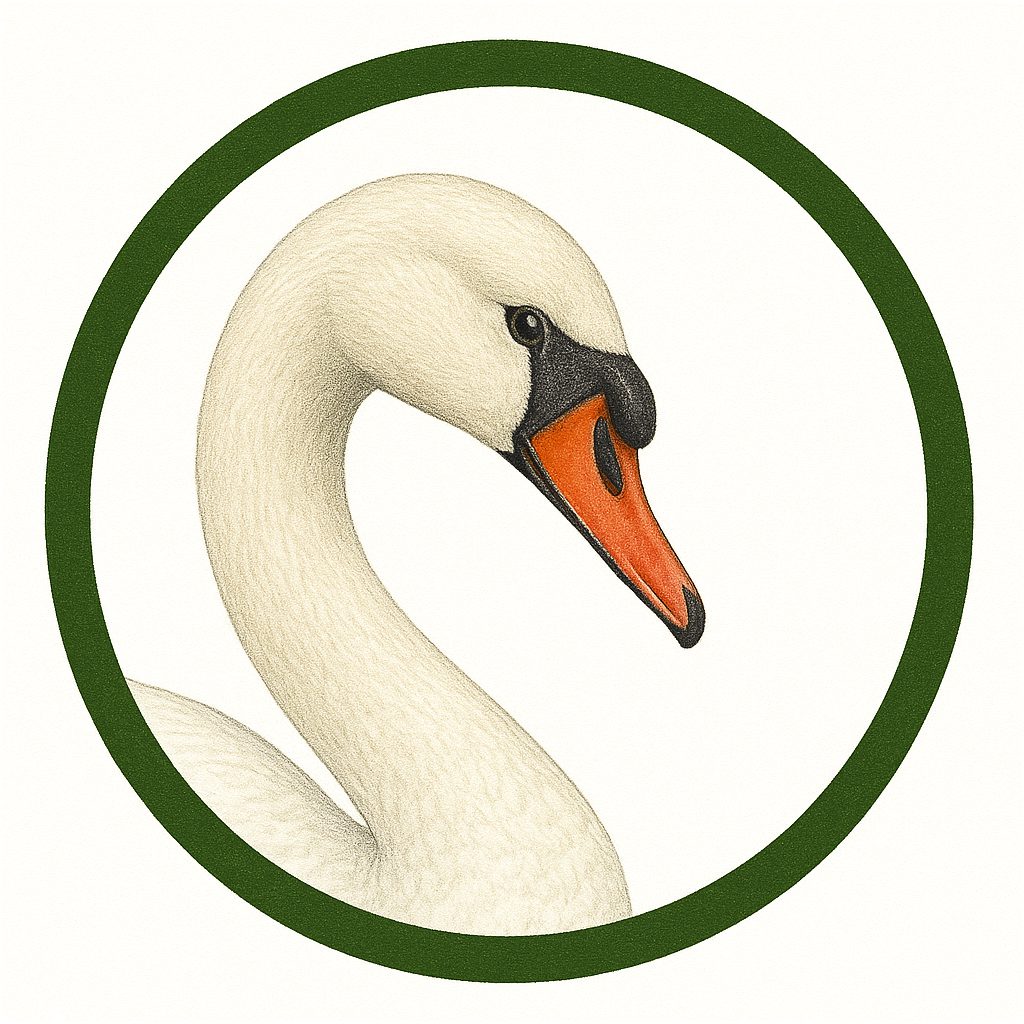
The mute swan (Cygnus olor) is one of the largest waterbirds in Europe, with an entirely white body, a long neck curved in an "S" shape and an orange bill with a prominent black knob at the base, more developed in males…
| Kingdom | Animalia |
| Phylum | Chordata |
| Class | Aves |
| Order | Anseriformes |
| Family | Anatidae |
| Genus | Cygnus |
| Species | Cygnus olor |
The mute swan (Cygnus olor) is one of the largest waterbirds in Europe, with an entirely white body, a long neck curved in an "S" shape and an orange bill with a prominent black knob at the base, more developed in males. Males can reach 1.52 m in length and weigh 10.5 kg on average, while females are somewhat smaller, with an average weight of 8.4 kg; the wingspan can reach 2.4 m.
Unlike other swans, it shows no difference in colouring between the sexes, although the male is visibly larger and heavier.
It occupies lakes, slow-flowing rivers with vegetation and, in winter, brackish estuaries, from north-eastern Europe and the British Isles to Scandinavia, central Europe and, irregularly, southern Siberia. It has been successfully introduced to North America, Australia, New Zealand and South Africa.
It feeds mainly on aquatic vegetation that it gathers from the bottom of lakes and rivers, supplemented with insects, small amphibians and crop seeds in spring.
Breeding takes place in spring. It builds a large nest of vegetation, up to 2 m across, on the ground or on floating islets, where the female generally lays three to eight bluish-green eggs. Incubation lasts between 35 and 38 days and is mainly carried out by the female. The cygnets, which often travel on their parents' backs, stay with them for 4 to 5 months.
The mute swan has been the national bird of Denmark since 1984 and has inspired works such as Hans Christian Andersen's tale "The Ugly Duckling" and Tchaikovsky's ballet "Swan Lake". In England, the Crown has long held rights of ownership over unmarked mute swans living in open water.