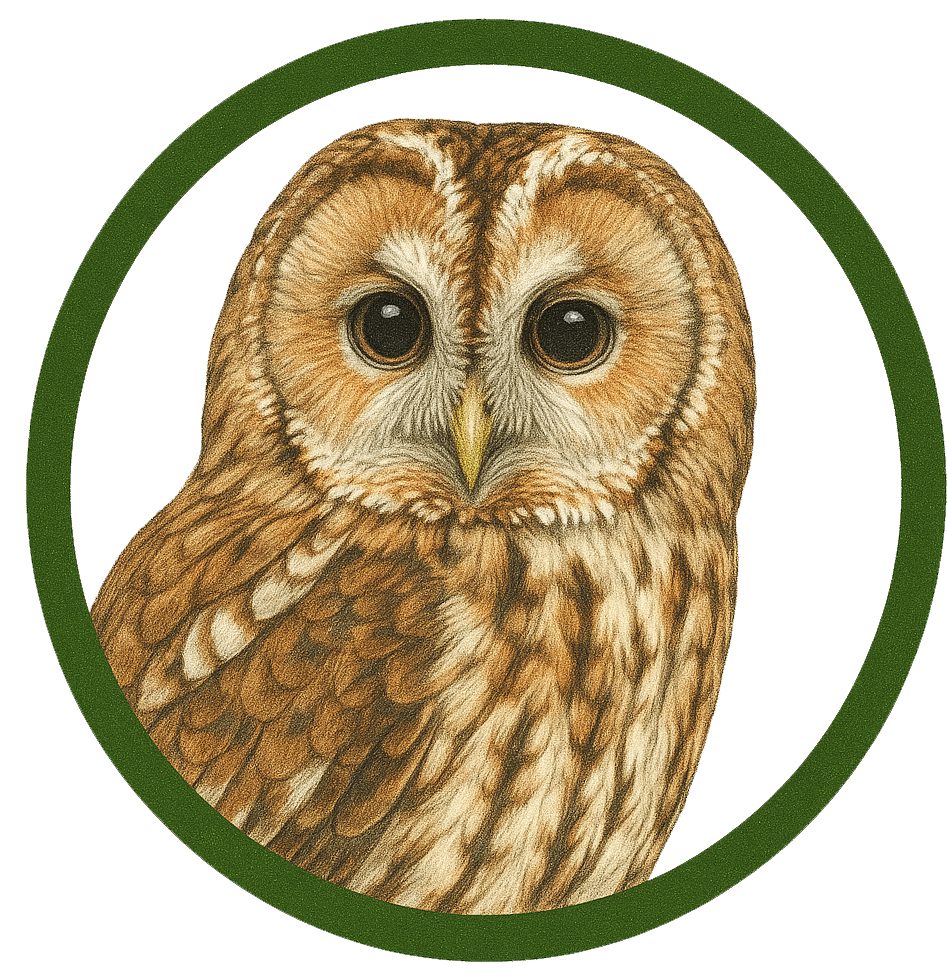
The tawny owl ( Strix aluco ) is a medium-to-large owl of the family Strigidae.
| Kingdom | Animalia |
| Phylum | Chordata |
| Class | Aves |
| Order | Strigiformes |
| Family | Strigidae |
| Genus | Strix |
| Species | Strix aluco |
The tawny owl (Strix aluco) is a medium-to-large owl of the family Strigidae. It measures between 37 and 40 cm in length, with a wingspan of 80 to 95 cm and a weight of over 600 grams; females are around 25% heavier than males. It has a broad, rounded head without ear tufts, dark eyes and a greyish-brown facial disc.
It occurs in two colour morphs, one reddish-brown and one greyish, both mottled with diagonal rows of white spots.
It is found across much of temperate Eurasia, from the British Isles — with the notable exception of Ireland — to western Siberia, with a separate population in the far east of Asia (China, Korea and Taiwan). It is a sedentary bird that lives mainly in deciduous and mixed woodland, and can be found from lowlands up to 2,800 m above sea level.
It hunts mostly at night and feeds mainly on rodents, although it also catches other small mammals — including young rabbits — birds and insects. In urban areas, birds make up a larger share of its diet.
It is monogamous for life and nests in tree hollows, abandoned nests of other species or nest boxes. The female incubates three to four eggs for about 30 days, and the chicks complete their development in 35-40 days.
It is extremely territorial during the breeding season, to the point of attacking the heads of anyone approaching the nest with its talons; the famous nature photographer Eric Hosking lost an eye in one such attack. Its hearing, as in other owls, is about ten times sharper than that of humans.