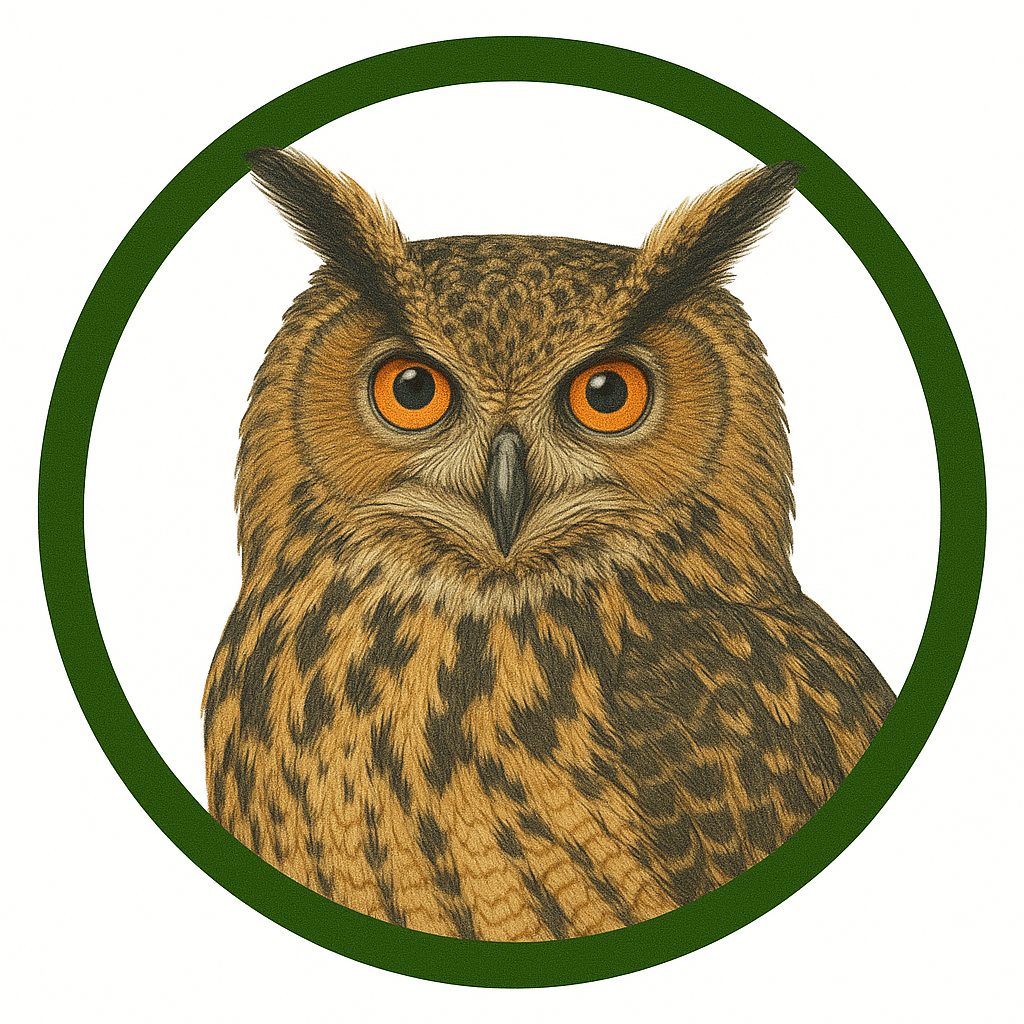
The great horned owl or tiger owl ( Bubo virginianus ) is one of the largest nocturnal birds of prey on the American continent, belonging to the same genus as the Eurasian eagle-owl.
| Kingdom | Animalia |
| Phylum | Chordata |
| Class | Aves |
| Order | Strigiformes |
| Family | Strigidae |
| Genus | Bubo |
| Species | Bubo virginianus |

The great horned owl or tiger owl (Bubo virginianus) is one of the largest nocturnal birds of prey on the American continent, belonging to the same genus as the Eurasian eagle-owl. It measures 43 to 64 cm in length, with a wingspan of up to 153 cm; females are notably heavier than males, exceeding 2.5 kg depending on the subspecies. It is distinguished by the tufts of feathers like “ears” on its head, its yellow iris (amber in the South American subspecies) and its very robust legs and talons.
Its large, cylindrical eyes and its ability to turn its head up to 270° give it exceptional vision in very low light.
It is one of the most habitat-adaptable birds in the world: it is found across almost the whole of the American continent, from northern North America to northern Argentina, absent only from the coldest Arctic regions and the heart of the Amazon rainforest. It occupies temperate forests, conifers, tropical rainforests, pampas, deserts, mangroves and even urban areas, reaching altitudes of up to 4,500 m in the Andes.
Its diet is very broad and includes small mammals, birds, reptiles and even fish, which reflects its status as an opportunistic, generalist predator.
It usually nests in tree hollows or reuses abandoned nests of other birds, where the female lays two to three eggs.
Its hearing is up to ten times more sensitive than that of humans, and thanks to the special structure of its feathers it can fly almost silently despite its size. In South America it is known by names of Guaraní origin such as ñacurutú or yacurutú, and it has historically been used in falconry.