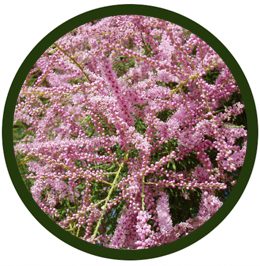
The tamarisk is a deciduous shrub or small tree with a feathery appearance, adapted to living in damp or saline soils or beside watercourses.
| Kingdom | Plantae |
| Division | Magnoliophyta |
| Class | Magnoliopsida |
| Order | Caryophyllales |
| Family | Tamaricaceae |
| Genus | Tamarix |
| Species | Tamarix gallica |
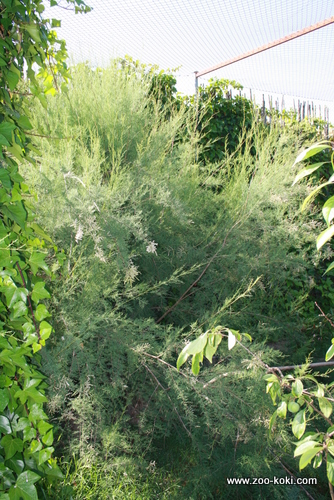
It is a deciduous shrub or small tree of up to 4 metres in height, feathery in appearance thanks to its fine twigs and tiny, blue-green, scale-like leaves. In summer it produces panicles of small white or pink flowers.
It is native to the western Mediterranean, occurring in France, Spain and Italy and in North Africa. In the Iberian Peninsula it is found mainly in marshes, salt flats, riverbanks and irrigation channels, where it tolerates soil salinity well.
Its enormous tolerance of salt and drought allows it to colonise soils where few other woody species survive, which is why it has traditionally been used to stabilise slopes and the banks of rivers and dry watercourses.