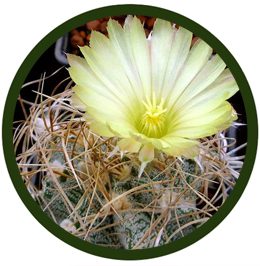
Astrophytum capricorne is a Mexican cactus with a spherical stem covered in white scales and armed with long, twisted spines that resemble a goat's horns.
| Kingdom | Plantae |
| Division | Magnoliophyta |
| Class | Magnoliopsida |
| Order | Caryophyllales |
| Family | Cactaceae |
| Genus | Astrophytum |
| Species | Astrophytum capricorne |
Astrophytum capricorne is a small cactus with a spherical stem that reaches 10 to 15 cm in height and up to 15 cm in diameter. It has 7 to 8 pronounced ribs, densely covered with woolly white scales that give it the speckled appearance characteristic of the genus.
Its most distinctive feature is its spines: 5 to 10 per areole, 3 to 7 cm long, yellowish to brown in colour and strongly curved and twisted, recalling the horns of an ibex, which is where it gets its name. It produces bright yellow flowers with a reddish throat, 6 to 7 cm long.
It is endemic to north-eastern Mexico, specifically the states of Nuevo León and Coahuila, where it grows mainly in desert and dry scrub biomes on stony soils.
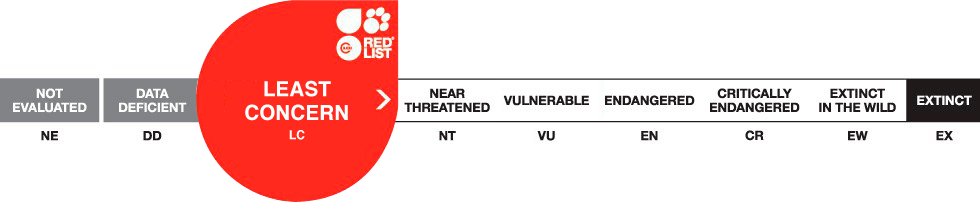
The International Union for Conservation of Nature classifies the species as “Least Concern”, although illegal collecting remains a local threat to some wild populations.
Its specific name, capricorne, refers directly to its spines, which curve like a goat's horn (“capricorn”), a feature that easily distinguishes it from other species of the genus Astrophytum, which generally have straighter spines or none at all.
It was originally described in 1851 as Echinocactus capricornis, and was not moved to the genus Astrophytum until 1922, by the botanists Nathaniel Britton and Joseph Rose.