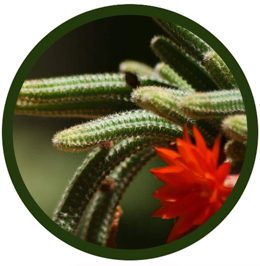
Echinopsis chamaecereus, known in English as the “peanut cactus”, is a small Argentine cactus with creeping stems and flowers of an intense orange-red colour.
| Kingdom | Plantae |
| Division | Magnoliophyta |
| Class | Magnoliopsida |
| Order | Caryophyllales |
| Family | Cactaceae |
| Genus | Echinopsis |
| Species | Echinopsis chamaecereus |
This small cactus stands out from its relatives by its growth habit: instead of an upright stem, it develops numerous slender, creeping stems barely a centimetre in diameter, with 8 to 10 ribs covered in areoles with small white spines. Over time it forms dense, trailing clumps that look very attractive in hanging pots.
Its light green colour can turn purplish when the plant receives a lot of direct light. In late spring it produces funnel-shaped flowers, radially symmetrical and about 4 cm in diameter, in a strikingly vivid vermilion red that contrasts with the rest of the plant.
It is endemic to north-western Argentina, in the province of Tucumán, where it grows in dry scrub and mountain desert areas, at altitudes ranging from 2,500 to 3,500 metres.
Curiously, botanical expeditions after its discovery failed to locate the plant again at its original site, so its exact status in the wild remains uncertain; the International Union for Conservation of Nature classifies it as “Data Deficient”.
It was first described in 1896 by the Italian-Argentine botanist Carlos Spegazzini, who named it Cereus silvestrii. Since then it has changed taxonomic genus several times, until receiving its current name, Echinopsis chamaecereus, in 1983.
It is one of the most cold-hardy cacti there is: it withstands frosts of down to -7 °C if kept dry, which, together with its ease of cultivation, has earned it the Award of Garden Merit from the British Royal Horticultural Society.