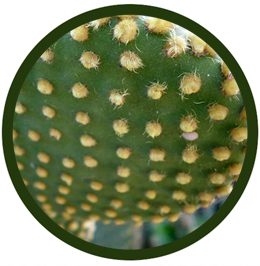
Opuntia microdasys, popularly known as ‘bunny ears’ or ‘blind prickly pear’, is a Mexican cactus with flattened pads covered in tiny, highly irritating glochids.
| Kingdom | Plantae |
| Division | Magnoliophyta |
| Class | Magnoliopsida |
| Order | Caryophyllales |
| Family | Cactaceae |
| Genus | Opuntia |
| Species | Opuntia microdasys |
Opuntia microdasys is a much-branched cactus that can form shrubby clumps of more than a metre in height, made up of oval, yellowish-green pads 8 to 15 cm long, covered in fine down. It lacks large spines, but its closely set areoles are packed with tiny yellow or brown glochids, small barbed spines that detach with great ease at the slightest touch.
In summer it produces pale yellow flowers with reddish tips, about 4 cm across, with white stamens and pistil, which give way to small fruits after pollination.
It is native to central and northern Mexico, where it grows naturally in arid and semi-arid areas on stony, well-drained soils, often forming extensive thickets alongside other cacti.
It is one of the most widely cultivated Opuntia species in the world as an indoor and outdoor ornamental plant, thanks to its showiness, ease of care and drought tolerance.
Its characteristic glochids are so dangerous that in Spanish it has popular names such as ‘cegador’, ‘nopal cegador’ or ‘nopalillo cegador’ (all meaning ‘blinding’), in reference to the serious eye injuries these tiny spines can cause to livestock grazing near the plant if they lodge in their eyes.
Several ornamental forms with glochids of different colours – white, yellow or reddish – have been selected in cultivation from this wild species, and are very popular with cactus enthusiasts for their decorative appearance.