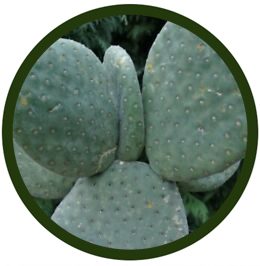
Opuntia microdasys 'Caress' is a cultivar of the classic Mexican ‘bunny ears’ or ‘blind prickly pear’ (‘nopal cegador’ in Spanish), selected for its glochids that are harmless to the touch.
| Kingdom | Plantae |
| Division | Magnoliophyta |
| Class | Magnoliopsida |
| Order | Caryophyllales |
| Family | Cactaceae |
| Genus | Opuntia |
| Species | Opuntia microdasys |
Opuntia microdasys is a much-branched cactus that forms shrubby clumps of up to one metre in height, made up of oval pads of 8 to 15 cm, yellowish-green and lacking true spines. Instead, it has closely set areoles covered in tiny glochids – very fine, barbed little spines – which in the typical species detach with great ease and are highly irritating.
The cultivar known as 'Caress' is distinguished precisely by its glochids: they are deformed, flattened structures, practically without barbs, which means the plant can be touched in complete safety, something exceptional within the genus Opuntia and the origin of the name of this horticultural selection.
The parent species, Opuntia microdasys, is native to central and northern Mexico, where it grows in arid and semi-arid areas. The 'Caress' variety is a cultivated selection developed from that wild species and does not exist as such in the wild, although it keeps the same growing requirements: full sun, little watering and a very free-draining substrate.
Like other prickly pears, it tolerates prolonged drought and high temperatures well, but it is sensitive to excess moisture and frost.
In the wild species the glochids are so dangerous that in Spanish it is known by popular names such as ‘cegador’ or ‘nopal cegador’ (‘blinding’ or ‘blinding prickly pear’), since they can lodge in the eyes of grazing livestock nearby and cause serious eye injuries.
The 'Caress' variety completely reverses that reputation: lacking functional barbs on its glochids, it is one of the few forms of Opuntia microdasys that can be stroked without risk, hence its English name, which means precisely ‘caress’.