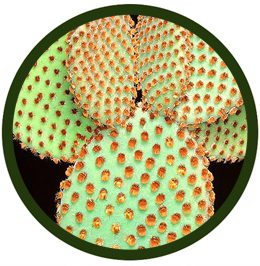
Opuntia microdasys var. rufida is a form of the Mexican prickly pear Opuntia microdasys with reddish-brown or cinnamon-coloured glochids, very close to the species Opuntia rufida.
| Kingdom | Plantae |
| Division | Magnoliophyta |
| Class | Magnoliopsida |
| Order | Caryophyllales |
| Family | Cactaceae |
| Genus | Opuntia |
| Species | Opuntia microdasys |
Opuntia microdasys is a much-branched cactus with flattened, oval pads of 8 to 15 cm in length, without large spines but with closely set areoles covered in tiny barbed glochids that detach easily at the slightest touch.
The form known commercially as ‘rufida’ is distinguished from the rest of the species by the reddish-brown or cinnamon colour of its glochids, very close to that of the closely related species Opuntia rufida, with which it is often confused in the plant trade; some botanists in fact consider that the two forms may be a single species.
Like the type species, it is native to central and northern Mexico, in arid and semi-arid habitats with stony, well-drained soils.
In cultivation it needs the same conditions as the rest of the species: full sun, little watering and a very porous substrate, as well as protection from hard frosts.
The distinction between this form and the related species Opuntia rufida is sometimes confusing even for specialists, as they share the same reddish tone of glochids; in general, O. rufida has larger pads and slightly more widely spaced areoles than Opuntia microdasys, but there is no definitive taxonomic consensus on whether they should be treated as separate species or as varieties of a single species.
As in the rest of the species, its glochids – although of a different colour – retain the same irritating capacity, so they must be handled with the same precautions as any other prickly pear.