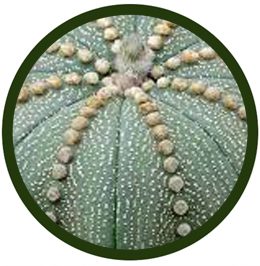
Astrophytum asterias is a small spineless cactus with a flattened, perfectly star-shaped body, as prized in cultivation as it is threatened in its natural habitat.
| Kingdom | Plantae |
| Division | Magnoliophyta |
| Class | Magnoliopsida |
| Order | Caryophyllales |
| Family | Cactaceae |
| Genus | Astrophytum |
| Species | Astrophytum asterias |
Astrophytum asterias is a spineless cactus with a flattened, globular body, measuring between 2.5 and 6 cm in height and 5 to 15 cm in diameter. Its brownish-green surface is dotted with small white scales (trichomes) evenly distributed.
It has between 7 and 10 barely marked ribs, separated by shallow grooves, with whitish areoles arranged like the arms of a star, which gives it its characteristic radial outline and its specific name, asterias (“starfish”). Its flowers, yellow with a reddish base, open during the day and can reach 6.5 cm across.
It occurs naturally from southern Texas, in the United States, to north-eastern Mexico, in the states of Tamaulipas and Nuevo León, in desert and dry scrub habitats on stony soils.
The species is listed as “Vulnerable” by the International Union for Conservation of Nature and protected under CITES Appendix I, owing to illegal collection, habitat destruction and accidental collection because of its resemblance to peyote.
It has been grown as an ornamental since the 1840s, although it grows very slowly and can take up to six years to flower for the first time. There are cultivated varieties highly prized by collectors, such as “Super Kabuto”, with a white mosaic pattern, or “Kikko”, with relief resembling a tortoise shell.
It is a plant that is very sensitive to excess moisture and root rot, so in cultivation it needs an extremely free-draining substrate and plenty of direct light.