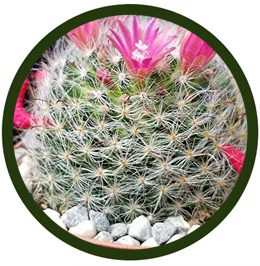
Mammillaria bocasana is a small, globular Mexican cactus covered in very fine, hair-like spines, with hooked, reddish-brown tips.
| Kingdom | Plantae |
| Division | Magnoliophyta |
| Class | Magnoliopsida |
| Order | Caryophyllales |
| Family | Cactaceae |
| Genus | Mammillaria |
| Species | Mammillaria bocasana |
Mammillaria bocasana is a globular-stemmed cactus about 5 cm in diameter, covered by a dense mat of very fine, white, silky radial spines that give it a soft, cottony appearance. Among them stand out one or two central spines, reddish-brown and with a tip curved into a hook, characteristic of the genus Mammillaria.
Over the years it forms clusters of numerous stems that can become truly eye-catching. In summer it produces small, pale yellow flowers with a reddish central stripe, which emerge crowning the top of the plant.
It is endemic to Mexico, specifically the states of San Luis Potosí and Zacatecas, where it grows on gentle limestone slopes in desert environments.
It is a species highly valued in cultivation for its ease of care: it grows well even in the hands of people with no previous experience of cacti, provided it is given a well-drained substrate and a cool, dry rest in winter.
Its hooked spines, common to the whole genus Mammillaria, serve a dispersal function: they catch easily on the fur of animals passing nearby, which helps carry fragments of the plant to other places.
It propagates easily from the side offsets it produces as it clusters; the cut surface is left to dry before planting, a standard technique in cactus propagation to prevent rotting.