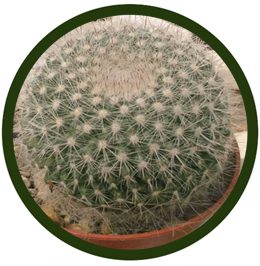
Mammillaria hahniana is a spherical Mexican cactus completely covered in a mantle of long white hairs, popularly known in cultivation as the “old man cactus” (“cactus viejito”).
| Kingdom | Plantae |
| Division | Magnoliophyta |
| Class | Magnoliopsida |
| Order | Caryophyllales |
| Family | Cactaceae |
| Genus | Mammillaria |
| Species | Mammillaria hahniana |
Mammillaria hahniana is a spherical-stemmed cactus that can reach up to 19 cm in height and 20 cm in diameter, forming clusters of several stems over time. Its conical areoles are covered by 20 to 30 fine, white, hair-like radial spines up to 1.5 cm long, together with 1 to 4 shorter central spines.
That abundant white hair covering the whole plant is its most distinctive feature and gives it a very characteristic hoary look. It produces purple flowers up to 2 cm in diameter, followed by small, also purplish fruits with brown seeds inside.
It is endemic to Mexico, where it is found in the states of Guanajuato, Querétaro and Tamaulipas, in arid desert habitats.
Its cultivation requires a highly draining mineral substrate and full sun, conditions that favour both the development of its characteristic white coat and its flowering.
The genus name, Mammillaria, comes from the Latin mammilla (tubercle or nipple), referring to the small conical tubercles that cover the stem of all species in the genus instead of continuous ribs.
The epithet hahniana pays tribute to Adolf Hahn, a German cactus collector from Berlin who died in 1954, a common practice in botany for recognising notable naturalists and collectors.