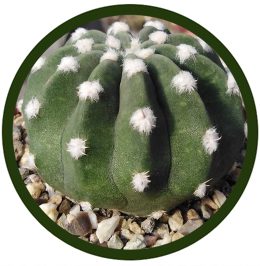
Echinopsis subdenudata is a globular cactus, almost without spines, from Bolivia and Paraguay, famous for its large, strongly scented white flowers that open at night.
| Kingdom | Plantae |
| Division | Magnoliophyta |
| Class | Magnoliopsida |
| Order | Caryophyllales |
| Family | Cactaceae |
| Genus | Echinopsis |
| Species | Echinopsis subdenudata |
Echinopsis subdenudata is a cactus with a globular stem, 8 to 12 well-marked ribs and areoles covered in whitish wool. Unlike most cacti, it has hardly any spines: only 3 to 7 tiny radial spines and one central spine of 1.5 to 2 mm, which in many specimens are completely absent.
Its flowering is its greatest attraction: it produces large tubular flowers 15 to 22 cm long, white or a very pale pink and strongly fragrant, which open for a single night before wilting, typically in spring and summer.
It is endemic to the Tarija region of Bolivia and to neighbouring areas of Paraguay, where it grows in arid mountain habitats. Since it was described it has spread enormously in cultivation all over the world, thanks to how easy it is to look after and its spectacular flowering.
It adapts well to pots in very free-draining mineral substrates, with moderate watering during the growing season and practically none during its winter rest.
Its specific name, subdenudata, comes from Latin and means roughly “almost naked”, a direct reference to the scarcity or absence of spines that sets it apart from other species of the genus Echinopsis.
It was formally described in 1956 by the Bolivian botanist Martín Cárdenas, one of the great specialists in the cactus flora of the Andes.