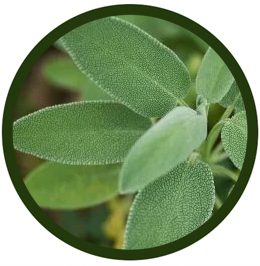
Sage is a small aromatic subshrub with greyish leaves, highly valued since antiquity for its culinary and medicinal properties.
| Kingdom | Plantae |
| Division | Magnoliophyta |
| Class | Magnoliopsida |
| Order | Lamiales |
| Family | Lamiaceae |
| Genus | Sage |
| Species | Salvia officinalis |

It is an evergreen perennial of up to 70 cm in height, with stems that are woody at the base and oblong, greyish-green leaves, wrinkled on the upper side and almost whitish underneath because of their fine downy covering.
From late spring through summer it produces spikes of tubular, violet-blue flowers, much visited by bees and other pollinators.

It is native to Mediterranean regions, occurring naturally in Spain, Italy, the Balkans and North Africa, on sunny slopes and well-drained limestone soils.
Its scientific name comes from the Latin “salvare” (to save or heal), alluding to the many medicinal properties attributed to it for centuries. In the Middle Ages it was said that whoever had sage in their garden enjoyed good health.