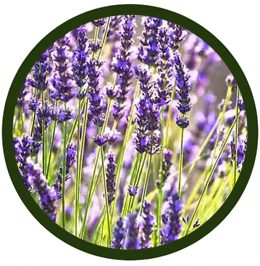
Lavender (Lavandula angustifolia) is an aromatic plant of the mint family, native to the western Mediterranean and famous for its spikes of bluish flowers and its intense perfume.
| Kingdom | Plantae |
| Division | Magnoliophyta |
| Class | Magnoliopsida |
| Order | Lamiales |
| Family | Lamiaceae |
| Genus | Lavandula |
| Species | Lavandula angustifolia |
The genus Lavandula comprises several dozen species of Mediterranean aromatic plants, and fine lavender or English lavender (Lavandula angustifolia) is one of the most representative and widely cultivated. It is a small shrubby plant with a woody base and square, herbaceous stems, which rarely exceeds a metre in height. Its leaves are narrow, elongated and greyish green, covered in a fine down that gives them a silvery appearance and helps the plant retain moisture.
Its violet-blue flowers are grouped in terminal spikes on long, bare stems that rise above the foliage. It is precisely in these flowers, and in the tiny glands of its leaves, that the essential oil responsible for its characteristic aroma is concentrated, one of the most recognisable in the plant world.
It is native to the western Mediterranean, with wild populations in southern France, Italy and the Iberian Peninsula, including coastal areas and the Balearic Islands. It grows naturally on sunny, stony slopes, often on well-drained limestone soils.
It is a plant that is very resistant to drought and direct sun, which is why it has spread as an ornamental and aromatic crop across much of Europe; in Mediterranean gardening, such as that of Zoo Koki, it is used both for its beauty and for its ability to attract bees and other pollinators.
Its name comes from the Latin lavare, «to wash», as the Romans used it to perfume their bathwater; the Spanish word «lavanda» comes from the same root.
Besides its use in perfumery and aromatherapy, dried lavender flowers have traditionally been used to keep moths out of wardrobes and to scent bed linen, a custom that is still alive in many homes.