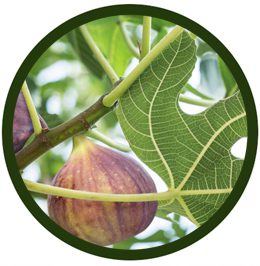
The fig tree (Ficus carica) is a tree of the mulberry family, native to south-west Asia, which has been cultivated in the Mediterranean basin since prehistoric times for its distinctive figs.
| Kingdom | Plantae |
| Division | Tracheophyta |
| Class | Magnoliopsida |
| Order | Rosales |
| Family | Moraceae |
| Genus | Ficus |
| Species | Ficus carica |

The fig tree is a deciduous tree, small or medium-sized, rarely exceeding 7 to 8 metres in height, with a broad, open crown on a trunk with smooth, greyish bark. Its leaves are large, between 12 and 25 cm, deeply lobed into three to seven lobes, a deep green and rough to the touch.
What we usually call a “fig” is not actually a simple fruit, but a fleshy, pear-shaped infructescence called a syconium, which contains dozens of tiny flowers inside; from the fertilised female flowers develop the little seeds that we notice when eating the fruit.
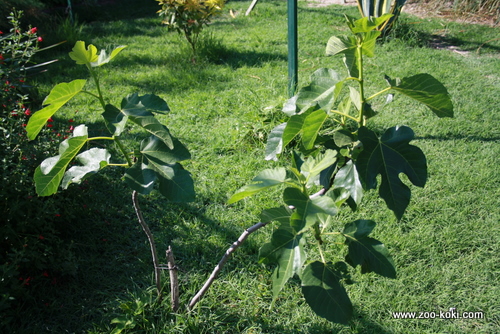
It is native to south-west Asia, although today it grows wild throughout the Mediterranean basin and in many other temperate regions of the world. It is a very hardy tree, able to take root in poor, stony soils, and it is common to see it sprouting from cracks in rocks and old walls.
Cultivated varieties are propagated mainly by cuttings and stand out for their remarkable ability to adapt to adverse conditions, including drought and poor-quality soils. According to the IUCN classification, the species is listed as Least Concern.
Subfossilised fig remains found at Gilgal I, in the Jordan Valley, date from between 9400 and 9200 BC, which has led some researchers to suggest that the fig tree may have been the first plant domesticated by humans, even before wheat.
Many varieties depend on a tiny wasp, Blastophaga psenes, for pollination: the female enters the syconium through a small opening, laying her eggs and carrying pollen at the same time, in a relationship of mutualism so close that neither species could survive without the other. However, most current commercial varieties produce fruit without the need for pollination, a phenomenon called parthenocarpy.