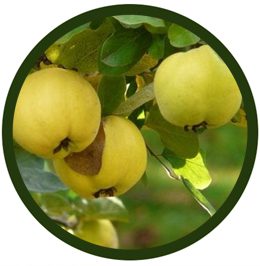
The quince tree (Cydonia oblonga) is a small fruit tree of the rose family, related to the apple and the pear, native to the Caucasus and cultivated for its aromatic, golden-yellow fruit.
| Kingdom | Plantae |
| Division | Magnoliophyta |
| Class | Magnoliopsida |
| Order | Rosales |
| Family | Rosaceae |
| Genus | Cydonia |
| Species | Cydonia oblonga |
The quince is a small to medium-sized fruit tree. Its leaves measure 6 to 11 cm long, with a surface densely covered in fine white hairs. The flowers, white or pink, appear in spring after the leaves.
Its fruit, the quince, is a pome that is bright golden yellow when ripe, pear-shaped, 7 to 12 cm long, with hard, highly aromatic flesh.
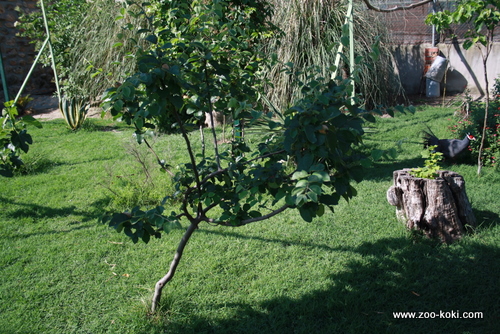
It is native to the Caucasus region, in the warm south-west of Asia (Iran, Armenia, Turkey). Since antiquity it has been widely cultivated in the Mediterranean basin, where it adapts well to temperate climates.
According to the philologist Joan Corominas, the Spanish word “membrillo” comes from the Greek melímelon (“honey apple”). Among the ancient Greeks, quince was offered at weddings, and Plutarch recounts that brides bit into a quince to perfume their kiss.