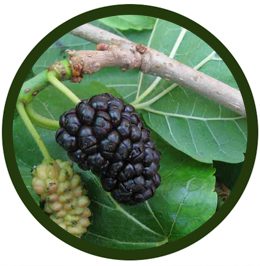
The black mulberry is a deciduous fruit tree native to south-western Asia, cultivated since antiquity for its tasty dark berries, its rough leaves and its valuable timber.
| Kingdom | Plantae |
| Division | Magnoliophyta |
| Class | Magnoliopsida |
| Order | Rosales |
| Family | Moraceae |
| Genus | Morus |
| Species | Morus nigra |
The black mulberry is a medium-sized tree, reaching between 10 and 13 metres in height, with a broad, spreading crown. Its leaves are large, 10 to 20 cm long, with a rough texture and an asymmetrical shape.
Its fruit, the mulberry, is a multiple fruit of small drupelets grouped in a cluster, a very dark purple, almost black, with a much-appreciated bittersweet flavour. It is a deciduous tree whose yellowish-white timber is valued for its resistance to damp.

It is native to south-west Asia, although its millennia of cultivation make it difficult to pinpoint its original range. It has been planted and has become widely naturalised in western Europe, Australia, Canada and China.
The syrup made from its mulberries has traditionally been used as a gargle to relieve inflammation of the mouth and throat. Its leaves, although less so than those of the white mulberry, also serve as food for silkworms.