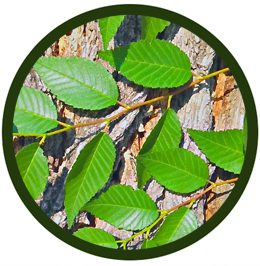
The Siberian elm is a very hardy deciduous tree native to central and eastern Asia, prized for its fast growth and its extraordinary tolerance of cold and drought.
| Kingdom | Plantae |
| Division | Magnoliophyta |
| Class | Magnoliopsida |
| Order | Rosales |
| Family | Ulmaceae |
| Genus | Ulmus |
| Species | Ulmus pumila |
It is a tree of up to 25 metres in height, with light to dark grey bark marked by longitudinal fissures. Its leaves, 2 to 8 cm long, are alternate with a serrated margin and only a very slightly asymmetrical base.
Its fruits are samaras with a rounded outline and a deep notch at the tip. Its crown is usually rounded and irregular, and it is a fast-growing tree, widely used as a windbreak.
It is native to a broad belt of Asia that includes Turkestan, eastern Siberia, Mongolia, northern China and Korea, where it grows in cold, dry continental climates. It has been widely cultivated in North and South America.
Because it is highly resistant to Dutch elm disease (unlike the American or European elm), it has been used in hybridisation programmes to create elm varieties tolerant of this disease.