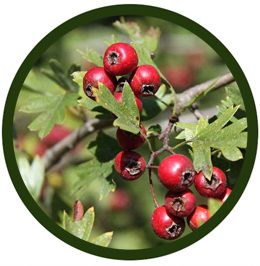
The hawthorn (Crataegus monogyna) is a thorny tree or shrub of the rose family, widespread across Eurasia and North Africa and typical of hedgerows and field edges.
| Kingdom | Plantae |
| Division | Magnoliophyta |
| Class | Magnoliopsida |
| Order | Rosales |
| Family | Rosaceae |
| Genus | Crataegus |
| Species | Crataegus monogyna |
The hawthorn is a woody plant that, depending on the terrain and pruning, can grow as a dense shrub or as a small tree of up to 10-14 metres. Its branches, covered in short, blunt thorns, form a thick crown that makes it an excellent living hedge. The leaves, 2 to 4 centimetres long, are deeply lobed, dark green on the upper surface and paler on the underside.
In spring it becomes covered in clusters of highly fragrant white flowers, with five petals and numerous reddish stamens, which in autumn give way to small red fruits known as haws or "shepherd's pears", each with a single stone inside. Its brown, cracked bark becomes rougher over the years.
It is native to all of Eurasia and North Africa, where it grows wild in open woodland, hedgerows, field margins and sunny hillsides. It adapts to a wide variety of soils, although it tolerates very prolonged summer droughts poorly.
Its thorny nature and density make it ideal as a refuge and food source for small birds and insects, which is why it is often part of living hedges and traditional field boundaries in the European countryside.
Its young leaves have traditionally been used in salads, and its fruits are made into jams, wines and aromatic liqueurs. In addition, extracts of its flowers and fruits are used in herbal medicine as a heart tonic, a use recognised even by health authorities for relieving mild heart-related complaints.
In Celtic folklore it was regarded as a sacred tree, associated with the entrance to the "Otherworld" and with the presence of magical beings, so cutting it down outside certain dates was considered an act of ill omen.