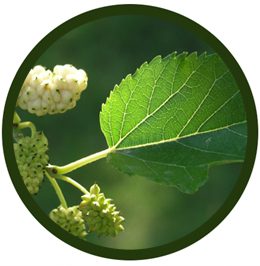
The white mulberry is a tree native to eastern Asia, famous for being the exclusive food of the silkworm and for its sweet multiple fruits, which despite its name can be white, purple or almost black.
| Kingdom | Plantae |
| Division | Tracheophyta |
| Class | Magnoliopsida |
| Order | Rosales |
| Family | Moraceae |
| Genus | Morus |
| Species | Morus alba |
The white mulberry is a tree that can reach up to 15 metres in height. Its leaves have a blade between 4 and 6 cm long, oval in shape, pointed at the tip and with an irregularly toothed margin.
Its fruit is a multiple fruit that can be white, whitish-purple or purple in colour, which explains why the name “alba” does not always match the actual colour of the fruit.
It is a tree native to the temperate zones of central and eastern Asia, specifically China, Manchuria and Korea. From there it has spread through human cultivation across Asia, Europe and the Americas.
The white mulberry is the plant that made sericulture possible: its leaves are the exclusive food of the silkworm (Bombyx mori), which made it a strategic crop along the historic Silk Road.