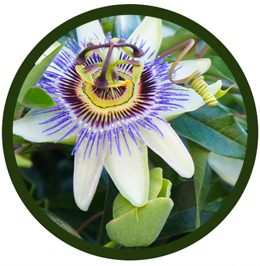
The blue passion flower (Passiflora caerulea) is a climbing plant of the passion flower family, native to South America and much prized as an ornamental for its distinctive bloom.
| Kingdom | Plantae |
| Division | Tracheophyta |
| Class | Magnoliopsida |
| Order | Malpighiales |
| Family | Passifloraceae |
| Genus | Passiflora |
| Species | Passiflora caerulea |
It is a woody climbing vine that clings to walls, fences and other plants by means of tendrils that grow from the leaf axils, and in favourable conditions it can reach 15 to 20 metres in length. Its leaves are palmate, divided into five lobes (sometimes seven), a deep green, and arranged alternately along the stem.
Its flower, about 8 centimetres across, is undoubtedly its most striking feature: whitish sepals and petals surround a showy corona of radiating white and bluish filaments, which frames the stamens and the ovary raised on a central structure. After flowering, an oval, orange fruit appears, similar to a small egg, containing numerous seeds wrapped in a reddish pulp.
It is native to South America, mainly Argentina, where it is the most widely distributed species of passion flower, although it is also found in Bolivia, Brazil, Uruguay, Paraguay and other countries on the continent. It grows in areas with alternating wet and dry seasons, with annual rainfall of between 600 and 1,200 mm, on well-drained soils rich in organic matter.
As an ornamental plant it has spread all over the world, including Spain, where it is grown in gardens and on pergolas thanks to its remarkable cold hardiness: it withstands temperatures of down to -10 or -15 °C, and although frost may damage its aerial parts, it usually resprouts from the base when the good weather returns.
Its name comes from the Spanish missionaries of the 16th century, who saw in the structure of its flower the symbols of the Passion of Christ: the three stigmas were said to represent the nails, the five stamens the wounds, and the filaments of the corona the crown of thorns, while the ten petals and sepals alluded to the apostles, excluding Judas and Peter.
In folk medicine, infusions of its leaves have traditionally been used as mild sedatives, while other parts of the plant have been used in various home remedies, although such preparations should always be used with care and good information.