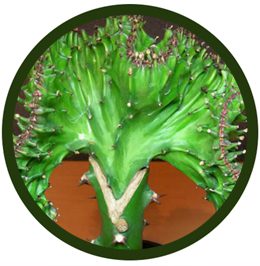
Euphorbia lactea is an Asian succulent shrub with angular, cactus-like stems, widely cultivated for its striking “crested” form (f. cristata) and its variegated varieties.
| Kingdom | Plantae |
| Division | Magnoliophyta |
| Class | Magnoliopsida |
| Order | Malpighiales |
| Family | Euphorbiaceae |
| Genus | Euphorbia |
| Species | Euphorbia lactea |
Euphorbia lactea is an upright succulent shrub that can exceed 5 metres in height, with fleshy branches triangular or rhomboid in cross-section, 3 to 5 cm in diameter, running with spiny ridges bearing small spines of up to 5 mm. It has tiny, deciduous leaves that are barely noticeable, since photosynthesis takes place in the stems themselves.
Although at first glance it closely resembles a columnar cactus, it is not one: it belongs to the spurge family, and like all of them it produces a milky latex inside that is toxic and irritating on contact with the skin or eyes. The crested form (f. cristata), in which the stem grows in a wavy fan shape because of a mutation of the meristem, is very popular in cultivation, as are grafted varieties with white or pink colouring.
It is native to the tropical regions of Asia, mainly India and Sri Lanka, where it grows in warm, dry climates. Over time it has become naturalised and widely cultivated in other tropical and subtropical regions, including Cuba and some parts of the Canary Islands.
It adapts well to growing in pots thanks to its drought tolerance and low watering needs, as long as it has good drainage and plenty of light.
Its specific name, lactea, refers precisely to the white, milky latex the plant secretes when cut, which has been used in a traditional, home-made way in Indian folk medicine, although handling it requires caution because of its toxicity.
Because of its sculptural habit and geometric forms, it is one of the succulents most used in ornamental gardening and in cactus and succulent arrangements, despite not being a true cactus.