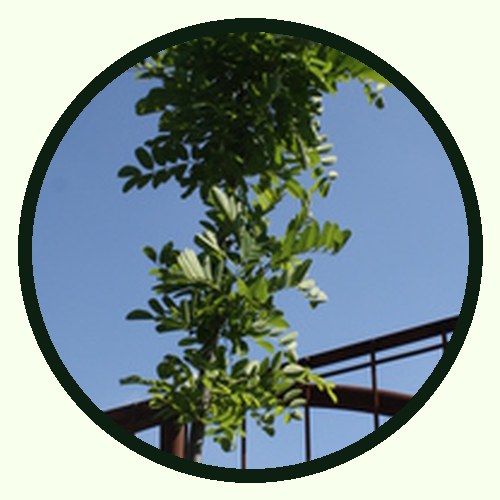
The false acacia is a fast-growing deciduous tree native to North America, with compound leaves and highly fragrant white flowers, now widely naturalised in Europe.
| Kingdom | Plantae |
| Division | Magnoliophyta |
| Class | Magnoliopsida |
| Order | Fabales |
| Family | Fabaceae |
| Genus | Robinia |
| Species | Robinia pseudoacacia |
It is a deciduous tree that can exceed 20 metres in height, with brown bark that is very rough and cracked lengthways. Its young branches have a pair of stipular spines at the base of each leaf, while in adult specimens they usually disappear.
Its leaves are compound and imparipinnate, made up of 7 to 19 oval, light green leaflets. In May and June it produces showy hanging clusters of white flowers, highly fragrant and rich in nectar for honey production, which give rise to flat, brown legume pods.
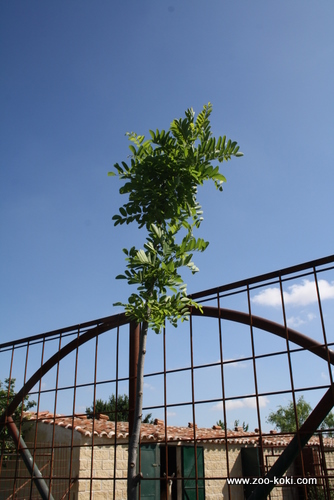
It is native to eastern and central North America, in particular the Appalachian region. It was introduced into Europe in the 17th century as an ornamental species and for stabilising slopes and dunes, because as a legume its roots fix atmospheric nitrogen.
It is now widely naturalised on the Iberian Peninsula, where it easily colonises roadsides, riverbanks and disturbed ground, which is why in some areas it is considered an invasive species.
Despite being called “acacia”, it does not belong to the genus Acacia but to Robinia, hence its common name “false acacia”. Its wood is very hard and resistant to rot, and has traditionally been used for vineyard posts and fencing.
Its flowers are greatly appreciated by bees and give rise to a highly prized monofloral honey, acacia honey.