
The brown eared pheasant ( Crossoptilon mantchuricum ) is a galliform bird species of the family Phasianidae, endemic to the montane forests of north-eastern China, in the provinces of Liaoning and Shanxi. No subspecies are known.
| Kingdom | Animalia |
| Phylum | Chordata |
| Class | Aves |
| Order | Galliformes |
| Family | Phasianidae |
| Genus | Crossoptilon |
| Species | Crossoptilon mantchuricum |
The brown eared pheasant (Crossoptilon mantchuricum) is a galliform bird species of the family Phasianidae, endemic to the montane forests of north-eastern China, in the provinces of Liaoning and Shanxi. No subspecies are known.
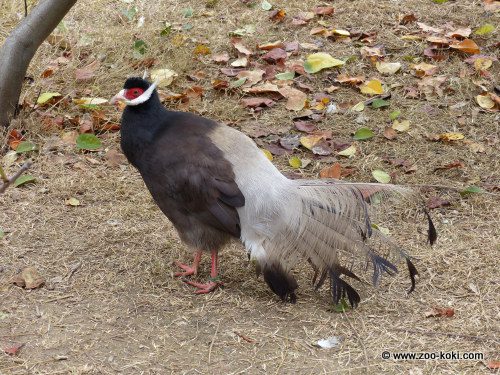
It is a large pheasant, with a total length of up to 96 to 100 cm, much of which is its long dark tail. Its common name, «eared», refers to the striking tufts of white feathers that grow on either side of the head like ears, contrasting with the dark brown plumage of the body and the bare red face.
It lives in mountain forests and scrubland in north-eastern China, moving between clearings with shrubby vegetation and forest edges in search of food. Its natural range is very small and fragmented, restricted almost entirely to the Chinese provinces of Liaoning and Shanxi.
It is a mainly herbivorous species: it feeds on roots, bulbs, shoots and other parts of plants, supplementing its diet with small invertebrates that it finds by scratching in the forest floor.
The female lays 5 to 8 large, pale green eggs, which she incubates for about 28 days. The chicks are nidifugous (precocial) and follow their mother shortly after hatching, foraging alongside her among the vegetation.
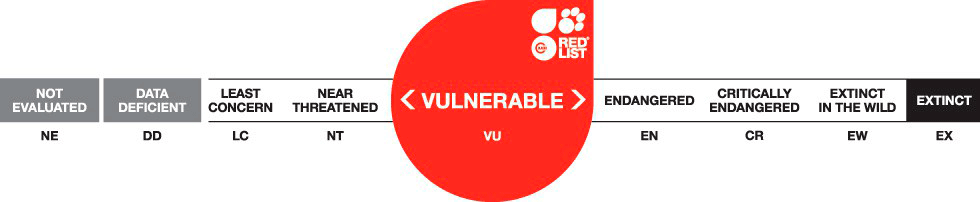
Because of the destruction of its forest habitat and poaching, the brown eared pheasant is listed as a Vulnerable species by the IUCN, with a very small, fragmented wild population in a few mountain areas of China.