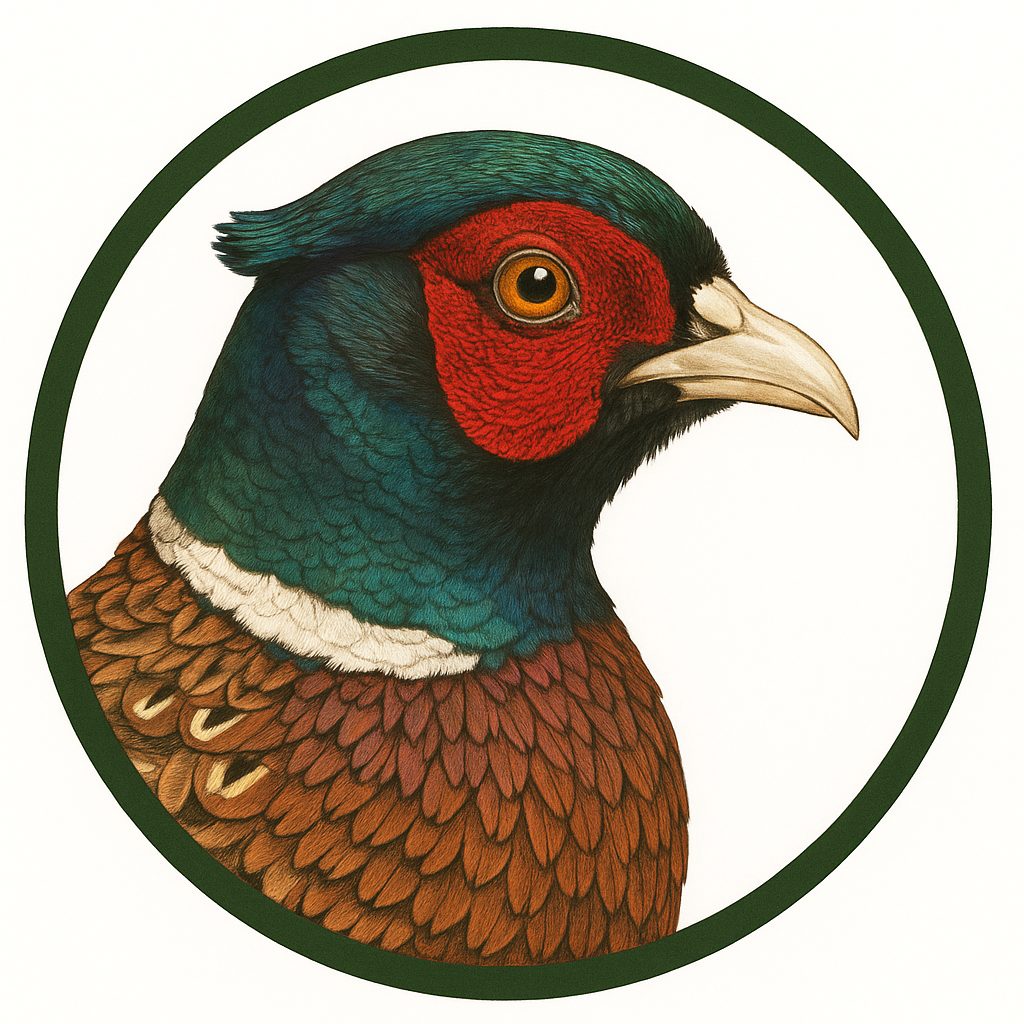
The common pheasant ( Phasianus colchicus ) is probably the best-known pheasant in the West.
| Kingdom | Animalia |
| Phylum | Chordata |
| Class | Aves |
| Order | Galliformes |
| Family | Phasianidae |
| Genus | Phasianus |
| Species | Phasianus colchicus |
The common pheasant (Phasianus colchicus) is probably the best-known pheasant in the West. The male displays bronzed plumage with iridescent violet, red and gold reflections, edged in black like scales, a dark green head with a blue and purple metallic sheen, red facial wattles and a long brown tail barred with black. The female is far more discreet, in brown tones with dark speckles. Males measure between 60 and 89 cm in length (including the tail) and females between 50 and 63 cm, with an average weight of 1.2 kg in males and 0.9 kg in females.
It is native to a broad belt stretching from the shores of the Black Sea and the Caspian Sea to eastern Asia, China, south-eastern Siberia, Korea and Taiwan, where it occupies grasslands close to lagoons and watercourses with nearby woodland. It has been successfully introduced as a game bird across much of the northern hemisphere and in countries such as Australia and New Zealand.
It is an omnivorous bird that forages on the ground: fruit, seeds and leaves form the basis of its diet, which it supplements with various invertebrates and, occasionally, small vertebrates such as reptiles or rodents.
It is a polygamous species: each male can form a harem of between 6 and 10 females, and fights between males for control of the group begin in mid-March. The nest, a simple hollow in the ground, is built between April and June at woodland edges, in meadows or in crops; the clutch is around ten eggs, incubated for 23 to 26 days. The chicks are precocial and can climb trees barely twenty days after hatching.
Its scientific name comes from the River Phasis (now the Rioni), in the ancient region of Colchis, beside the Black Sea, where mythology places the meeting of Jason and the Argonauts with these birds. Up to thirty subspecies have been described, with notable differences in plumage, especially in the presence or absence of a white neck ring and in the colour of the rump.