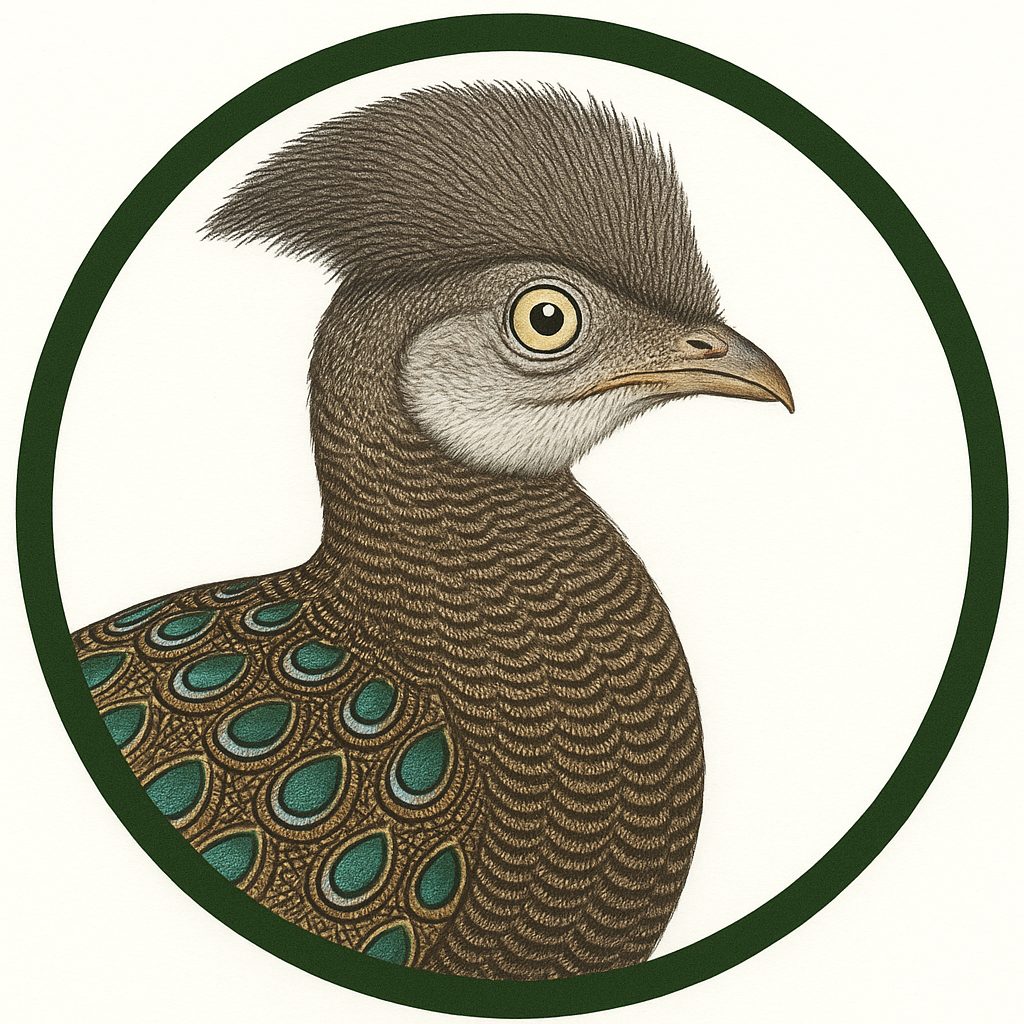
The grey peacock-pheasant ( Polyplectron bicalcaratum ) is a bird of the family Phasianidae that can reach up to 76 cm in length.
| Kingdom | Animalia |
| Phylum | Chordata |
| Class | Aves |
| Order | Galliformes |
| Family | Phasianidae |
| Genus | Polyplectron |
| Species | Polyplectron bicalcaratum |
The grey peacock-pheasant (Polyplectron bicalcaratum) is a bird of the family Phasianidae that can reach up to 76 cm in length. Its plumage is greyish brown, speckled with showy ocelli (eye-shaped spots) with green and violet reflections on the wings and tail, more developed and striking in the male. The females are noticeably smaller and duller in colour, with white and black markings instead of iridescent ocelli.
It inhabits humid lowland forests and mountainous areas up to 1,800 m in altitude in north-eastern India, Bhutan, Assam, Myanmar, Thailand, Laos, Vietnam and the Chinese island of Hainan.
It feeds mainly on the forest floor, searching for seeds, termites, fruit and other invertebrates among the leaf litter.
During the breeding season, the male performs an elaborate frontal display to the female, raising and spreading the feathers of the body and tail to show off his ocelli to the full, accompanied by vocalisations. The clutch is usually very small, typically just two eggs, which the female incubates.
The striking ocelli of the grey peacock-pheasant have been the subject of scientific studies on sexual selection, as they act as a decisive visual lure in mate choice. Up to five subspecies are recognised, with geographical variation in the size and arrangement of these spots.