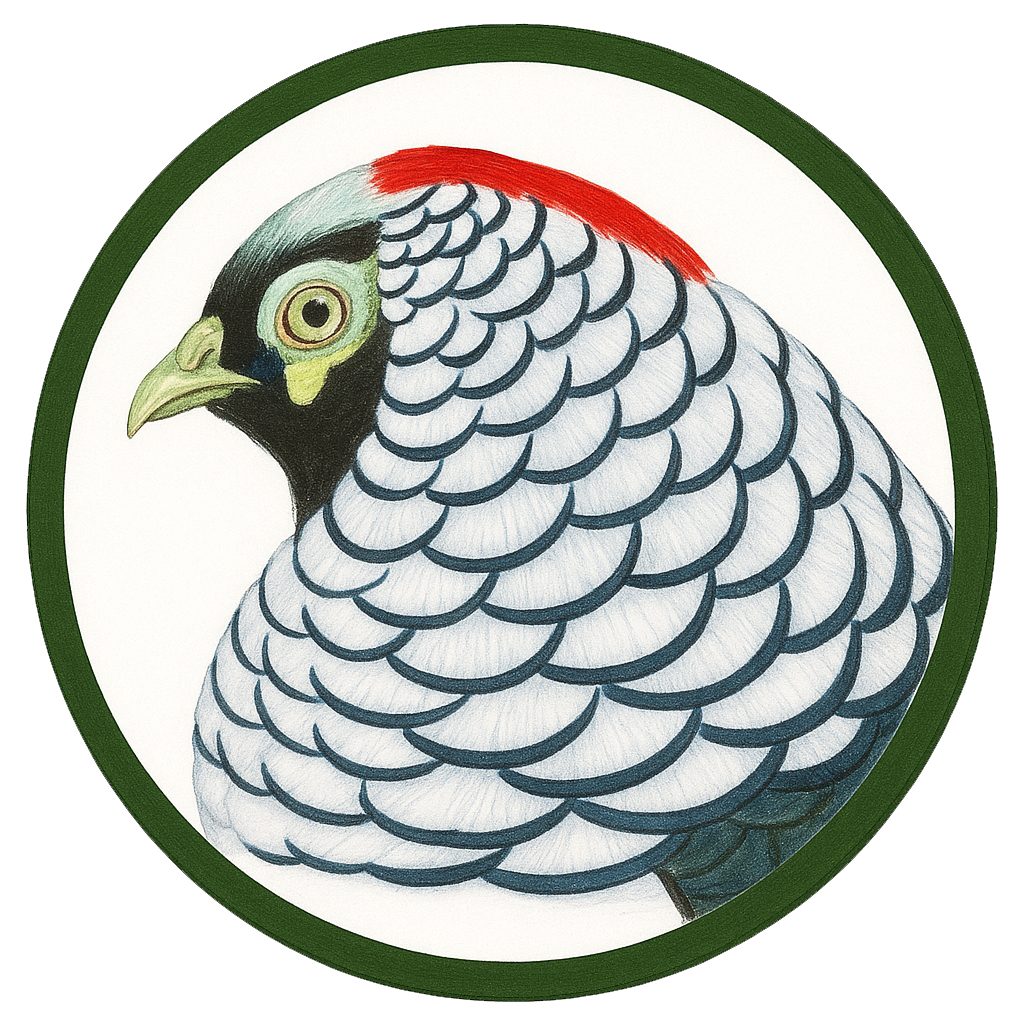
Lady Amherst's pheasant (Chrysolophus amherstiae) is an unmistakable bird thanks to the contrast of its black and silver head, its long broad grey tail and the red and blue touches of its plumage, which is completed by white and yellow tones on the body; it can…
| Kingdom | Animalia |
| Phylum | Chordata |
| Class | Aves |
| Order | Galliformes |
| Family | Phasianidae |
| Genus | Chrysolophus |
| Species | Chrysolophus amherstiae |
Lady Amherst's pheasant (Chrysolophus amherstiae) is an unmistakable bird thanks to the contrast of its black and silver head, its long broad grey tail and the red and blue touches of its plumage, which is completed by white and yellow tones on the body; it can raise its showy ruff during courtship. The male measures 100 to 120 cm in length, of which about 80 cm is tail. The female, much less showy, has mottled chestnut plumage similar to that of the female common pheasant, although with a darker head and a cleaner belly.
It is native to south-eastern Tibet, south-western China and northern Burma, where it occupies dense, shady forests with thick undergrowth. It has been introduced outside its natural range, and feral populations exist in England.
It feeds by scratching at the ground in search of grain, leaves and invertebrates, supplementing its diet according to the seasonal availability of seeds and shoots.
It is a polygamous species: the male courts several females and gives a harsh call during the rutting season. Laying begins in mid-April, with clutches of 12 to 15 white eggs that the female incubates alone for 24-25 days. After breeding, the pheasants may form groups of up to 30 individuals outside the breeding season.
It is named after Sarah, Countess Amherst, wife of the Governor-General of Bengal, who is credited with sending the first specimen to London in 1828. It is a close relative of the golden pheasant, with which it can hybridise in captivity and in the feral populations of England; despite the spectacular appearance of the male, it is a very hard bird to observe in its natural habitat.