
The Mikado pheasant (Syrmaticus mikado) is a bird of the family Phasianidae with no recognised subspecies.
| Kingdom | Animalia |
| Phylum | Chordata |
| Class | Aves |
| Order | Galliformes |
| Family | Phasianidae |
| Genus | Syrmaticus |
| Species | Syrmaticus mikado |
The Mikado pheasant (Syrmaticus mikado) is a bird of the family Phasianidae with no recognised subspecies. The male, up to 70 cm long, has dark plumage with bluish and violet sheens and striking white bands on the wings and tail; the female, up to 47 cm, is brown and mottled, with a considerably shorter tail.
It is a species endemic to the mountains of central Taiwan, where it lives in high-altitude forests, moving along the forest floor and mountain paths.
It eats a varied diet of fruit, leaves, vegetation, seeds and invertebrates, which it seeks out by moving across the forest floor much like a farmyard fowl.
The breeding season runs from March to June. The female lays three to eight cream-coloured eggs, which she incubates alone for 26 to 28 days; she is also solely responsible for rearing the chicks, which become independent at around six months of age.
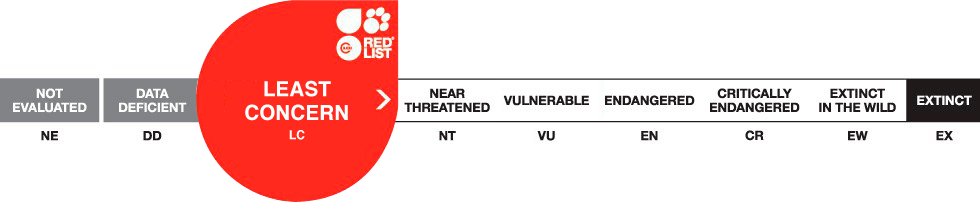
Endemic to Taiwan and protected through its inclusion in Appendix I of CITES, the Mikado pheasant has seen its population recover thanks to the protection of its mountain forests: the 2023 IUCN assessment reclassified it from «Near Threatened» to «Least Concern», with a stable estimated population of between 20,000 and 100,000 adult birds.