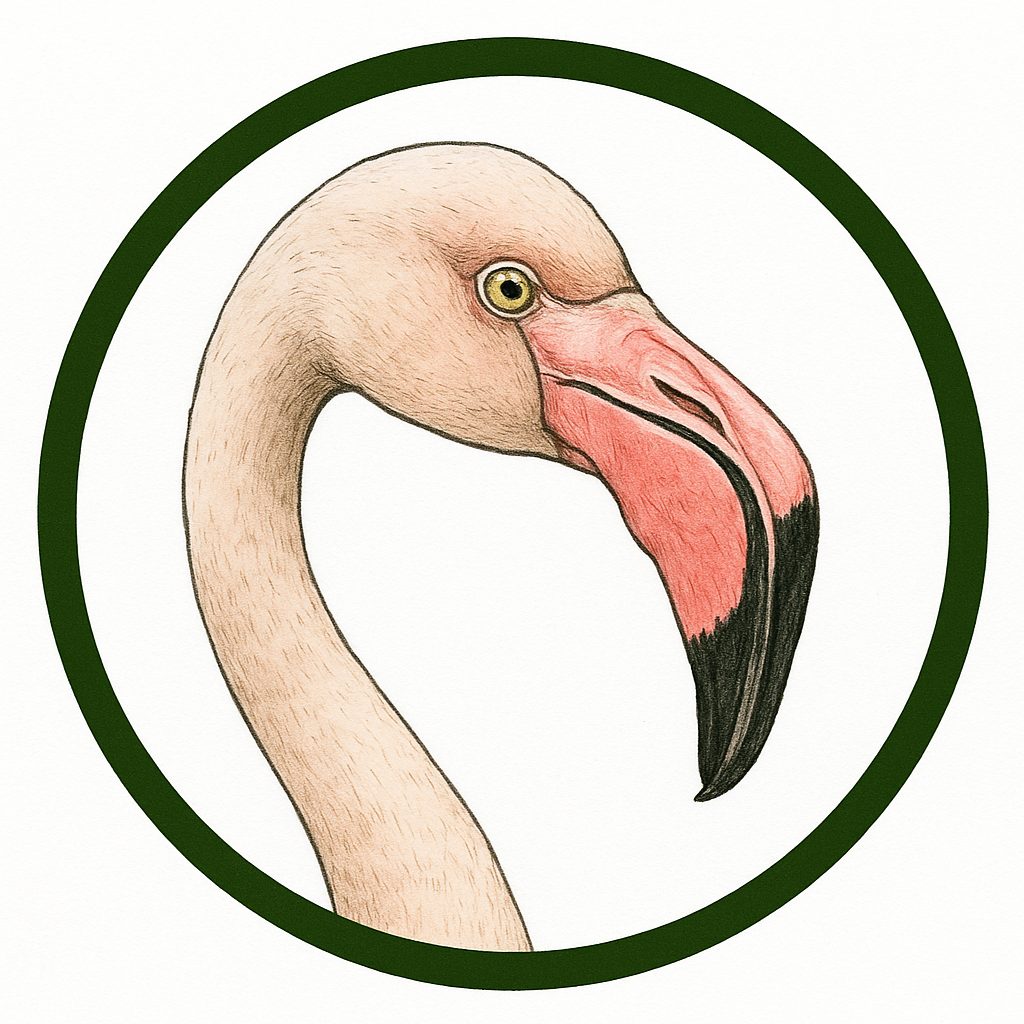
The greater flamingo (Phoenicopterus roseus) is the largest species of flamingo, standing between 110 and 150 cm tall and weighing 2 to 4 kg, although the largest males can exceed 4.5 kg and 187 cm in height.
| Kingdom | Animalia |
| Phylum | Chordata |
| Class | Aves |
| Order | Phoenicopteriformes |
| Family | Phoenicopteridae |
| Genus | Phoenicopterus |
| Species | Phoenicopterus roseus |
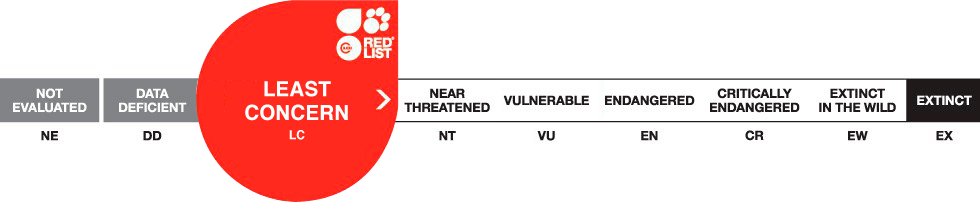
The greater flamingo (Phoenicopterus roseus) is the largest species of flamingo, standing between 110 and 150 cm tall and weighing 2 to 4 kg, although the largest males can exceed 4.5 kg and 187 cm in height. Its plumage is predominantly pale pink, with the wing feathers a more intense, sometimes reddish shade, and the primaries and secondaries black. The bill is pink with a black tip and the legs are entirely pink.
Young birds have whitish-grey plumage and gradually acquire the adult pink colouring over several years, depending on the carotenoid pigments they obtain from their food.
It lives in saline and brackish lagoons, salt pans and coastal marshes in Africa, southern Europe and south-western Asia as far as India. In Spain it breeds in wetlands such as the Fuente de Piedra lagoon, Doñana or the Odiel marshes, and many European populations migrate to North Africa in winter.
It feeds by filtering water through its characteristic downward-curved bill to catch small crustaceans, microscopic algae and other planktonic organisms; these organisms, rich in carotenoids, are responsible for its characteristic pink colour.
It breeds in colonies, often very large, and builds a mound-shaped nest of mud beside the water. Each pair lays a single whitish egg.
Flamingos can gather in feeding flocks of more than a million birds, coordinating alarm behaviour in the face of possible dangers. The greater flamingo is also one of the emblematic species of the in situ conservation programmes that Zoo Koki supports in Mediterranean wetlands, thus contributing to the protection of its wild populations.