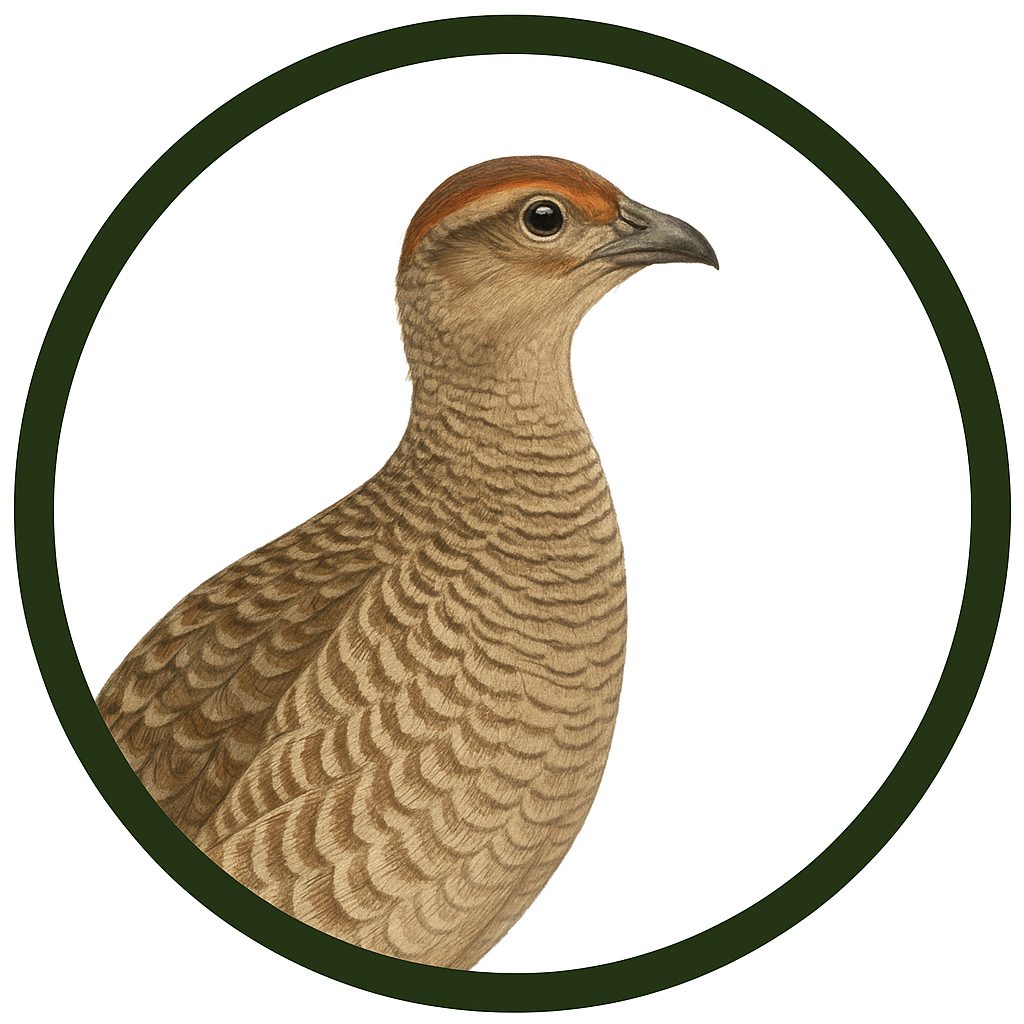
The grey francolin ( Ortygornis pondicerianus , previously classified in the genus Francolinus ) is a galliform bird of the family Phasianidae, medium-sized, with greyish-brown plumage barred all over the body.
| Kingdom | Animalia |
| Phylum | Chordata |
| Class | Aves |
| Order | Galliformes |
| Family | Phasianidae |
| Genus | Ortygornis |
| Species | Ortygornis pondicerianus |
The grey francolin (Ortygornis pondicerianus, previously classified in the genus Francolinus) is a galliform bird of the family Phasianidae, medium-sized, with greyish-brown plumage barred all over the body. It has a pale face bordered by a thin black line around the pale throat. Males can develop up to two spurs on the legs, which are absent or poorly developed in females.
Males measure between 29 and 34 cm and weigh 260 to 340 g, while females are somewhat smaller, at 26-30 cm and 200-310 g. In flight it shows a chestnut tail and dark primary feathers.
It is native to the Indian subcontinent and Iran, where it lives in open farmland, scrub and areas of low vegetation or bare ground. It is rarely found above 500-1,200 m above sea level. It has been successfully introduced to other regions, such as Hawaii.
It feeds mainly on seeds and grain, as well as insects such as termites and beetles; occasionally it catches larger prey, including small snakes.
The breeding season runs from April to September. It nests in a simple hollow scraped into the ground, well camouflaged among the vegetation, and the usual clutch consists of six to eight eggs.
Its local name in the Indian subcontinent, "teetar", comes from its characteristic call, which sounds like "ka-tee-tar... tee-tar". It is a weak flier that prefers to escape from predators by running or by making short flights into the undergrowth.