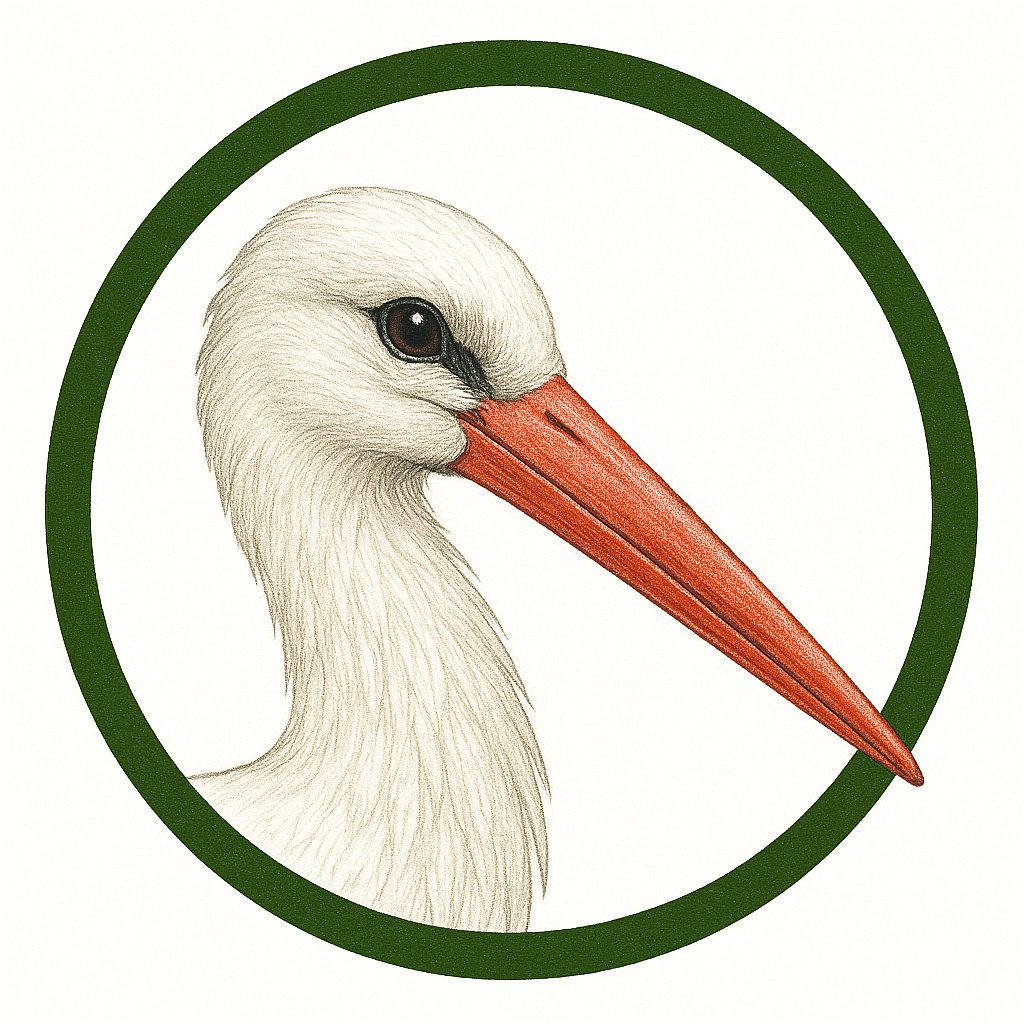
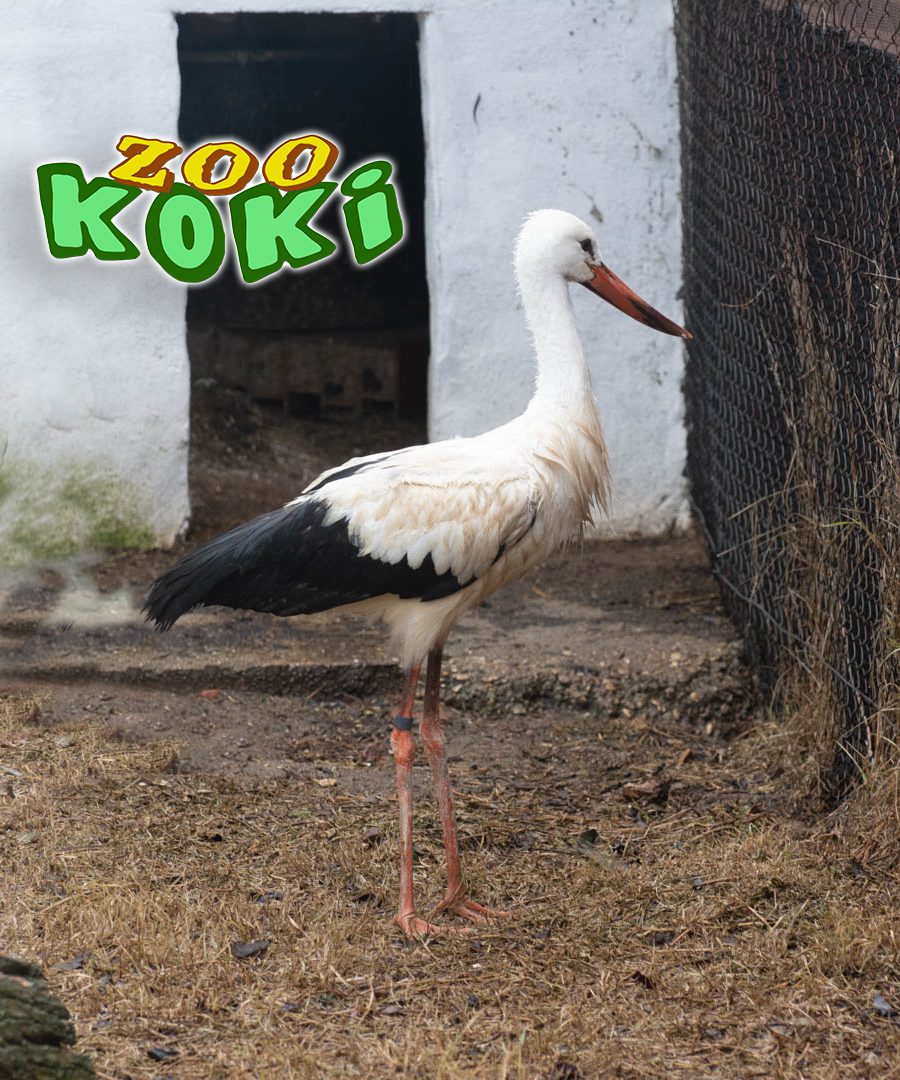
The white stork (Ciconia ciconia) is a large bird of the order Ciconiiformes, belonging to the family Ciconiidae. Its plumage is mostly white with black on the wings, and the legs and bill of adults are red.
| Kingdom | Animalia |
| Phylum | Chordata |
| Class | Aves |
| Order | Ciconiiformes |
| Family | Ciconiidae |
| Genus | Ciconia |
| Species | Ciconia ciconia |
The white stork (Ciconia ciconia) is a large bird of the order Ciconiiformes, belonging to the family Ciconiidae. Its plumage is mostly white with black on the wings, and the legs and bill of adults are red. It measures on average 100 to 115 cm from the tip of the bill to the end of the tail, and its wings can span between 155 and 215 cm. The two subspecies, which differ slightly in size, breed in Europe, north-eastern and southern Africa and south-western Asia. 25% of the world population is concentrated in Poland.
The white stork's preferred feeding grounds consist of green pastures, farmland and shallow wetlands. It avoids areas covered with tall grass and shrubs. For example, in the Chernobyl region of northern Ukraine, white stork populations declined after the 1986 nuclear accident, when cultivated land was abandoned and turned into wasteland with shrubs and tall grass. In some regions of Poland, poor conditions in natural feeding areas have forced the birds to look for food at rubbish dumps since 1999. There are also reports of white storks foraging at rubbish tips in the Middle East, North Africa and southern Africa outside the breeding season.
It feeds on a wide variety of animal prey. It prefers to forage in grasslands within about 5 km of its nest, in places with short vegetation, which makes it easier to reach its prey. Its diet varies with the season, the locality and the availability of prey. Common prey includes insects – mainly beetles, grasshoppers, locusts and crickets – earthworms, reptiles, amphibians – in particular frogs, such as the edible frog (Pelophylax kl. esculentus) and the common frog (Rana temporaria) – and small mammals such as mice, moles and shrews. Less common prey includes young birds and birds' eggs, fish, molluscs, crustaceans and scorpions. It hunts mainly by day, swallowing small prey whole, but it usually kills and tears up larger prey before swallowing it. It sometimes swallows rubber bands that it mistakes for earthworms, which can result in a fatal blockage of the digestive tract.
The white stork breeds in open farmland with access to marshy wetlands; it builds a large nest at the top of trees or buildings, or on artificial platforms put up specifically for the purpose. The nest is built of branches and sticks, and has a diameter of 0.8–1.5 m and a depth of 1–2 m, and weighs between 60 and 250 kg. Nests are often built in colonies whose composition may vary over the years.
Because they were considered a good omen, storks were not persecuted and often nest near human settlements; in southern Europe, stork nests can be seen on church bell towers and other buildings. The nest is usually used year after year, especially by older males. Males arrive early in the breeding season and choose the nests. Larger nests are associated with greater breeding success and seem to be sought after. Changing nests is often linked to a change in the make-up of the pair and to a lack of breeding success the previous year; younger birds are more likely to change nesting site.
The make-up of the pair may change several times during the first phase of the breeding season, and breeding will only begin once a stable pairing has been established
The white stork has had a notable impact on folklore and human culture because of its habit of nesting near or within human settlements, its large size, and its preying on pests. In Ancient Egypt it was associated with the hieroglyph of the Ba, or "soul".
The Hebrew word for the white stork is chasidah, meaning "merciful" or "kind".
Greek and Roman mythology portrayed white storks as models of parental devotion, and they were believed not to die of old age but to fly off to islands and take on the appearance of human beings. The bird appears in two of Aesop's fables: The Fox and the Stork and The Farmer and the Stork.
They were also believed to look after their elderly parents, feeding them and even carrying them, and children's books presented them as a model of filial values. A Greek law called pelargonia, derived from the Greek word pelargos for stork, obliged citizens to take care of their ageing parents. The Greeks also decreed that the killing of a stork could be punished by death.
It was reportedly protected in ancient Thessaly, for hunting snakes and because of the common belief that it was Virgil's "white bird". Roman writers mentioned that the arrival of the white stork in spring was the signal for farmers to plant their vines
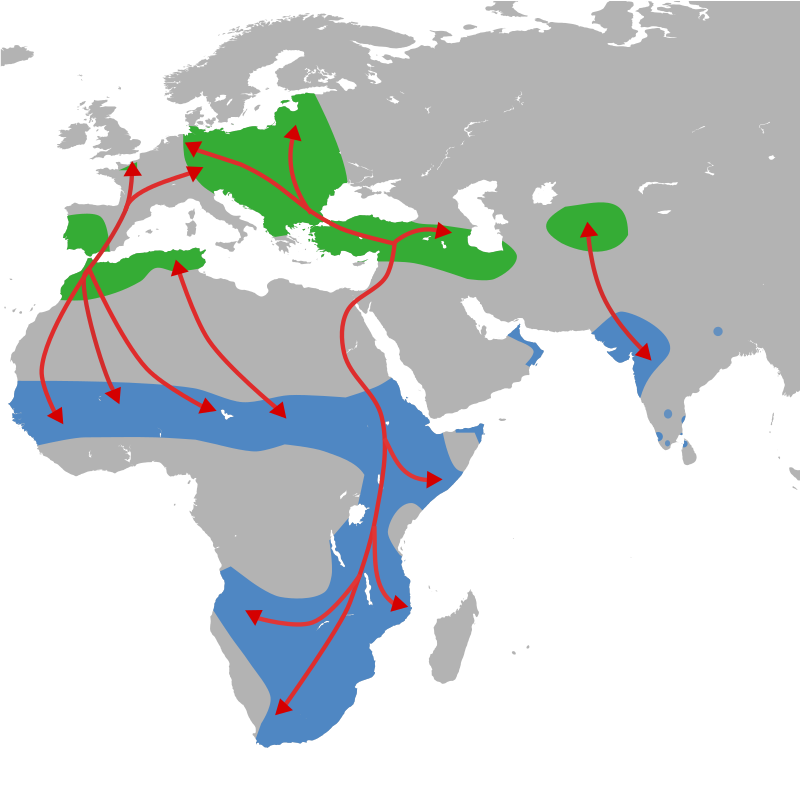 Source: Wikimedia Commons — WhiteStorkMap.svg