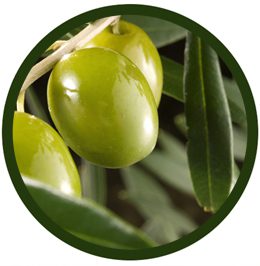
The olive tree (Olea europaea) is a small evergreen tree, a symbol of the Mediterranean basin, cultivated for thousands of years for its fruit, the olive.
| Kingdom | Plantae |
| Division | Magnoliophyta |
| Class | Magnoliopsida |
| Order | Lamiales |
| Family | Oleaceae |
| Genus | Olea |
| Species | Olea europaea |
The olive tree (Olea europaea), also called “olivera” or “aceituno” in Spanish, is an evergreen tree that can reach up to 15 m in height, with a thick, twisted-looking trunk and grey or silvery bark.
Its leaves are opposite and lanceolate, and its flowers, which are hermaphrodite, are grouped in panicles with a white corolla. The fruit, the olive, is a drupe between 1 and 3.5 cm long, from which olive oil is obtained.
Flowering takes place between May and July, and fruiting between September and December in the northern hemisphere. The wild olive (Olea europaea var. sylvestris) is its wild variety, shrubby in habit with smaller fruits.
Fossil evidence places the origin of the olive tree between 20 and 40 million years ago in the eastern Mediterranean basin, although its cultivation as an edible plant began about 7,000 years ago.
Olives were already being cultivated commercially in Crete around 3000 BC, and may have been one of the sources of wealth of the Minoan civilisation.
The Spanish word “olivo” comes from the Latin olīvum, itself taken from Greek, while in Spanish “aceituna” and “aceite” come from the Arabic az-záyt — a curious reflection of the different cultures that have cultivated this tree throughout history.