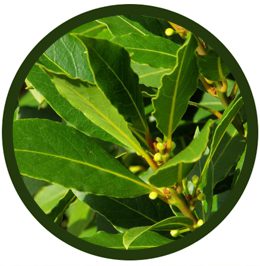
The bay laurel (Laurus nobilis) is an aromatic evergreen tree of the laurel family, native to the Mediterranean region and widely cultivated since antiquity for its foliage and symbolic value.
| Kingdom | Plantae |
| Division | Magnoliophyta |
| Class | Magnoliopsida |
| Order | Laurales |
| Family | Lauraceae |
| Genus | Laurus |
| Species | Laurus nobilis |
The bay laurel is a small to medium-sized tree that normally reaches between 5 and 10 metres in height, although in cultivation it is usually kept pruned as a hedge or ornamental small tree. It is a dioecious species, meaning that there are separate male and female plants, with a dense, dark green crown and a straight trunk covered in smooth, greyish bark.
Its leaves, well known for their use in cooking, are lanceolate, leathery and a deep green, with a characteristic balsamic aroma when rubbed or dried. In spring, small yellowish flowers appear, clustered in the leaf axils and not very showy, followed in autumn by oval berries that go from green to bluish black as they ripen.
It is a species native to the Mediterranean basin, occurring naturally in southern Europe, North Africa and parts of south-western Asia, as well as in places along the Atlantic coast of the Iberian Peninsula. It grows well in mild, temperate climates, tolerating direct sun and some summer drought, although it appreciates cool, well-drained soils.
Like the rest of the Mediterranean vegetation, it adapts easily to the climate of Toledo, withstanding both hot summers and moderately cold winters, provided that waterlogging of the soil is avoided.
In Greek mythology, the laurel was sacred to the god Apollo, who made it a symbol of victory and glory following the legend of the nymph Daphne, who was turned into this tree to escape from him; hence laurel wreaths were awarded to poets, athletes and heroes.
That same tradition lives on in words such as «laureate» or «bachelor» (from the Latin baccalaureatus, «crowned with laurel berries»), and its dried leaves remain one of the most common seasonings in the stews, soups and casseroles of Mediterranean cooking.